









“I almost drowned as a child,” Cristina Alvarado, director of programming at the Rose Bowl Aquatics Center, told a small audience gathered at the center on Thursday, sharing her story publicly for the first time. “I remember looking up. I didn’t panic, but I knew in a quiet, heavy way that I had just made a mistake.”
Alvarado managed to grab a small raft and pull herself to safety. She used the moment to frame the message city officials, public health experts and aquatic safety advocates had come to deliver in observance of Water Safety Awareness Month: drowning is preventable, but only through education, vigilance and access to swim instruction — and the threat extends well beyond children.

“Water safety isn’t just about preventing death,” Alvarado said. “It’s about enabling life.”
Speakers from the City of Pasadena, the Pasadena Public Health Department, the Pasadena Fire Department and the Rose Bowl Aquatics Center emphasized that drowning often occurs silently and within seconds, contradicting the dramatic struggle scenario often depicted on television and in movies.
A risk that climbs with age
Dr. Matthew Feaster, an epidemiologist with the Pasadena Public Health Department, said Pasadena’s drowning data doesn’t match common assumptions.
“While more than 23% of drownings occur among individuals or children under 18, you might be surprised that actually 31% of our drownings here in Pasadena are among older adults,” Feaster said.
The local figures track closely with national trends. According to the U.S. Centers for Disease Control and Prevention’s most recent Vital Signs report, adults aged 65 and older have the second-highest drowning rate in the United States, behind only children ages one to four. Drowning deaths among Americans aged 65 to 74 rose 19% in 2022 compared with 2019, and deaths among those 85 and older jumped nearly 50% in 2021. More than 4,500 Americans died from unintentional drowning each year between 2020 and 2022 — about 500 more annually than before the pandemic.
Feaster cautioned residents against swimming alone or while impaired by alcohol or medications that may cause drowsiness. He added that properly maintained pools are also critical to preventing waterborne illnesses and mosquito-borne diseases.
“A couple seconds”
Pasadena Fire Chief Chad Augustin said misconceptions about how drowning unfolds continue to put residents at risk.
“Drownings take only a couple of seconds to occur, which is the amount of time it takes to look down and look back up at your electronic device,” Augustin said.
Drowning research indicates that submersion can render a victim unconscious within 20 to 60 seconds, and that the recognition window — the time a bystander has to notice something is wrong — is brief and often deceptive. Victims rarely thrash or call out.
Augustin emphasized that even strong swimmers can drown due to exhaustion, cramps or dangerous ocean conditions.
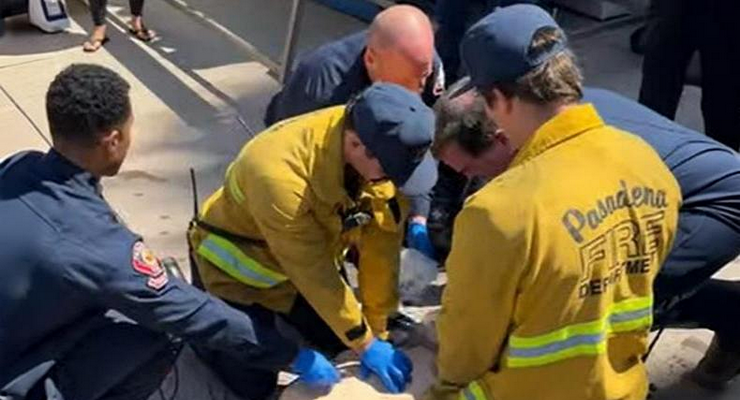
After the speeches, Augustin and a Pasadena Fire Department rescue crew demonstrated a simulated drowning and pool rescue, ending with immediate CPR on the pool deck — a reminder of how quickly the chain from distress to cardiac arrest can run.
A councilmember who learned as an adult
District 1 Councilmember Tyron Hampton, who has championed the “Get in the Swim” partnership between the city and RBAC for students at Washington Multilingual STEAM Academy, spoke personally about learning to swim as an adult after a neighbor’s family lost a child to drowning.
“I decided I needed to learn how to swim, and I learned how to swim here at the Rose Bowl Aquatics Center,” Hampton said.
CDC survey data show roughly 40 million American adults — about 15% — do not know how to swim, and more than half have never taken a lesson. The disparities are sharpest by race: more than one in three Black adults reported they cannot swim, and roughly two-thirds said they have never taken a lesson, compared with 15% of all adults overall.
A long-running PUSD partnership
Officials highlighted the partnership between RBAC and the Pasadena Unified School District, which the center says has provided water safety instruction to more than 28,000 third-grade students since the program’s inception. RBAC, founded in 1990 with funds left over from the 1984 Olympic Games, currently serves approximately 1,000 PUSD third-graders each school year. Each student receives 15 lessons along with a swimsuit, workbook, towel service and family swim passes — at no cost to the family.
The PUSD Board of Education in August approved a $102,156 memorandum of understanding for the 2025–26 school year, expanding the program to include select fourth-grade students.
RBAC Executive Director Melanie Sauer said the partnership reflects a shared civic commitment.
“Drowning is something that is preventable,” Sauer said. “Water safety and swimming lessons are essential. It’s an essential life skill, and that’s why we partner with the city — because in our opinion, we do this together.”
Sauer urged residents to encourage family members and neighbors to enroll in swim lessons, learn CPR and remain attentive around water as warmer weather approaches.
How to enroll
Residents seeking swim lessons or CPR training can contact the Rose Bowl Aquatics Center at rosebowlaquatics.org or by calling the center directly. Financial assistance is available for families who qualify. The American Red Cross Los Angeles Region offers CPR certification courses, and the Pasadena Fire Department can direct residents to local options; schedules are posted at redcross.org.
For backyard pool safety, the CDC recommends four-sided fencing at least four feet high with self-closing, self-latching gates that fully separate the pool from the home.
 Get our daily Pasadena newspaper in your email box. Free.
Get all the latest Pasadena news, more than 10 fresh stories daily, 7 days a week at 7 a.m.


