









A new radio dish has risen from the Mojave Desert and begun catching signals from spacecraft scattered across the solar system — and the lab that runs it sits in Pasadena.
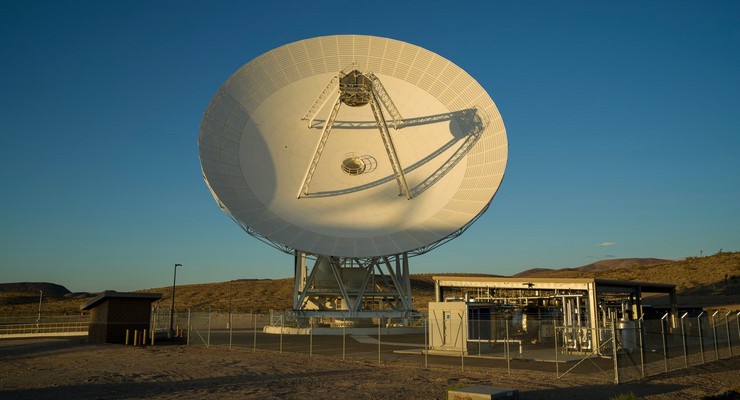
The antenna, Deep Space Station 23, is a 34-meter-wide (114-foot) dish at NASA’s Goldstone Deep Space Communications Complex near Barstow. It is operated by the Jet Propulsion Laboratory, the NASA center that Caltech manages, and it is the fifth of six new antennas NASA has been adding to its Deep Space Network under a project begun in 2009. NASA said in an announcement that the dish began operations on Aug. 3, and that agency and JPL leadership gathered at the antenna for a ceremonial ribbon-cutting on Aug. 25.
For all the desert setting, the work behind the dish is a Pasadena story. JPL manages the Deep Space Network for NASA — the trio of antenna complexes, in California, Spain and Australia, that lets the agency track, command and gather data from more than 40 spacecraft, according to NASA.
The new antenna spent its first weeks earning its keep. After a testing campaign from May through July, DSS-23 began by tracking NASA’s Chandra X-ray Observatory, the agency said. Since then it has traded signals with a roster of deep-space veterans: the Mars Reconnaissance Orbiter, the asteroid probe Psyche, the Jupiter orbiter Juno, and Voyager 1, now in interstellar space.
Building it took years. Construction began in February 2020. In December 2024, crews lowered a 133-ton steel reflector framework onto the antenna’s pedestal and bolted it into place, then fitted the panels that bounce radio signals to and from spacecraft. What followed was the slow work of calibration — teaching the dish to operate in concert with the rest of the network.
“The biggest challenge wasn’t actually constructing the antenna. It was transforming a complex collection of mechanical, electrical, software, radio frequency, and infrastructure systems into a single, mission-ready asset,” said Germaine Aziz, who manages the network’s Aperture Enhancement Project at JPL, in the NASA announcement. “Every subsystem must be integrated, calibrated, and verified to operate with extraordinary precision and reliability before it can support NASA’s deep space missions.”
The dish is a multifrequency beam-waveguide antenna, a design that routes signals down into a climate-controlled underground room instead of packing sensitive electronics onto the moving dish. NASA says the layout makes the equipment easier to reach and upgrade. When the network needs more power, the 34-meter antennas can be combined to stand in for the aging 70-meter dishes that have run for more than half a century.
“The addition of this next-generation antenna brings us closer to a completely modernized network that embraces advanced technology to ensure NASA’s leadership in deep space communications,” said Dave Gallagher, JPL’s director, in the announcement. “After over 60 years of continuous operations supporting consequential missions, these upgrades prime the network for a new era of exploration. The teams that designed, planned, and built DSS-23 should be proud.”
DSS-23 is the fifth antenna at Goldstone and the fifth of the six new dishes to come online, NASA said. The last one, Deep Space Station 33 in Canberra, Australia, is expected in 2029, which would bring the network to 13 of the 34-meter antennas.
The desert complex is more than 100 miles from Pasadena. But the oversight runs through JPL, which Caltech operates for NASA, and through the agency’s Space Communications and Navigation program. More than 100 NASA and non-NASA missions depend on the Deep Space Network and its companion Near Space Network, the agency said — from astronauts on the International Space Station to spacecraft exploring the far edges of the solar system.
 Get our daily Pasadena newspaper in your email box. Free.
Get all the latest Pasadena news, more than 10 fresh stories daily, 7 days a week at 7 a.m.


