








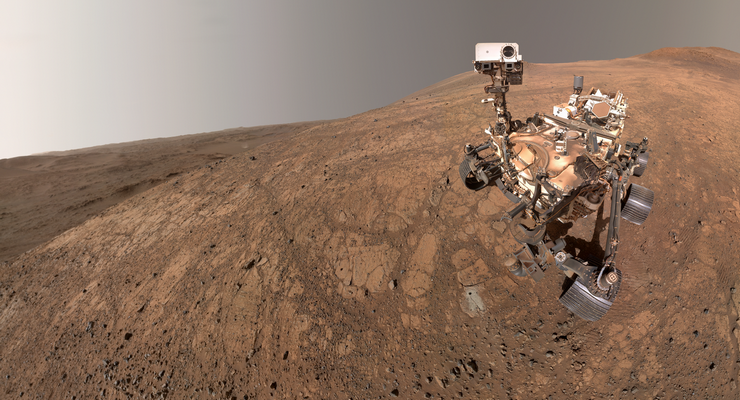
NASA’s Perseverance rover, built and operated by Jet Propulsion Laboratory in Pasadena, has found evidence that repeated asteroid strikes helped construct a 245-foot-thick sequence of rocks on the rim of Mars’ Jezero Crater more than 3.9 billion years ago.
The findings, published Wednesday in the Journal of Geophysical Research: Planets, could help scientists reconstruct a period of intense bombardment early in the solar system’s history. NASA described the research in a news release issued July 15.
The formation, known to the Perseverance science team as the “Broom Point member,” contains alternating layers of fragmented rock and finely pulverized material that scientists believe were deposited by multiple impact events. The rocks are among the oldest terrain examined directly by a rover on Mars.
Perseverance began studying the formation after reaching the western rim of Jezero Crater in late 2024. Its instruments identified six distinct rock types within the roughly 75-meter-thick sequence.
Some layers contain breccias, rocks made up of angular fragments, while others consist of fine-grained rock dust. Cavities resembling frozen gas bubbles appear in some of the fragments, indicating that the material was once molten.
Researchers also found numerous small, dark, glassy beads within the layers. Volcanic activity can produce similar droplets, but scientists said the beads’ abundance points more strongly to asteroid impacts. Some of the largest beads are comparable in size to material ejected by the Chicxulub impact on Earth, which is associated with the extinction of the dinosaurs.
The recurring pattern of fragmented rock, pulverized material and glassy beads suggests that the region was affected by a series of high-energy impacts rather than a single event.
“The different rock layers are a record of variable-sized impacts occurring at different distances from where this rock sequence was accumulating,” said Alex Jones, a doctoral student in planetary geology at Imperial College London and the paper’s lead author.
Some large impacts occurred far from the site, Jones said, while smaller impacts may have taken place nearby. Debris from those events accumulated in the area now being examined by Perseverance, gradually forming the thick section of rock.
The discovery offers scientists a view of a period that is difficult to study on Earth. Plate tectonics has altered, buried or destroyed much of Earth’s earliest crust, erasing a substantial portion of the planet’s early impact history.
Mars does not have the same system of active plate tectonics recycling its crust, allowing some of its oldest rocks to remain comparatively intact.
“On Earth, our earliest geologic history has been fundamentally broken up, deformed, and erased by plate tectonics,” said Ken Farley, Perseverance’s deputy project scientist and a professor at Caltech in Pasadena. “Because Mars lacks plate tectonics to recycle its crust, this ancient record remains intact, giving us a rare glimpse into a geological time period that doesn’t exist on our own planet.”
Farley said Perseverance’s exploration beyond the interior of Jezero Crater has taken the mission into terrain that predates the crater itself.
The researchers said some Broom Point layers also may preserve evidence of interactions involving water or ice. Several appear to have been deposited by fast-moving, ground-hugging debris flows.
On Earth, similar fluidlike surges can occur when molten rock encounters water or ice, instantly converting it into steam. Scientists have not yet determined whether the Martian formations were created through the same process, and the NASA release described that interpretation as a possibility rather than a confirmed conclusion.
The orientation of the rocks provides another clue to the region’s history. Some layers tilt at angles greater than 80 degrees, making them nearly vertical.
Researchers concluded that the impact that created Jezero Crater could not, by itself, account for such steeply tilted formations.
Instead, they suspect that two major impact events reshaped the area at different times.
The first created Isidis Basin, an impact structure about 1,200 miles, or 1,900 kilometers, wide and one of the largest basins on Mars. That impact may have overturned and tilted rock layers that originally formed horizontally.
A later asteroid strike created Jezero Crater, which is about 28 miles, or 45 kilometers, across. Scientists believe the second impact fractured and lifted the previously tilted rocks, producing the formations Perseverance is examining today.
The rover has collected two core samples from the area, named “Bell Island” and “Main River.” Should a future mission return those samples to Earth, laboratories could use precise dating techniques to determine when the layers formed and how frequently major impacts were occurring.
Such measurements also could provide indirect information about conditions on the young Earth, which experienced many of the same early solar system impacts but no longer preserves a complete geological record of them.
Jones described the layers as a record of a period when molten droplets and pulverized dust generated by asteroid impacts repeatedly fell across the Martian surface.
Determining the ages of the layers, he said, would allow scientists to read what he called a “cosmic weather report from 4 billion years ago.”
JPL built Perseverance and manages the rover’s operations for NASA’s Science Mission Directorate as part of the agency’s Mars Exploration Program. Caltech manages JPL for NASA.
The Pasadena laboratory also built Perseverance’s SHERLOC instrument, formally known as the Scanning Habitable Environments with Raman and Luminescence for Organics and Chemicals instrument.
Other institutions have major responsibilities for the rover and its scientific instruments. Arizona State University leads operations of the Mastcam-Z camera system and worked with Malin Space Science Systems in San Diego on the cameras’ design, fabrication, testing and operation.
Los Alamos National Laboratory in New Mexico leads the SuperCam instrument, whose main body was developed there. Malin Space Science Systems built WATSON, the rover’s close-up imaging camera.
The findings therefore reflect work by the broader Perseverance science and engineering team, including JPL, Caltech, Imperial College London, Arizona State University, Los Alamos National Laboratory, Malin Space Science Systems and other mission partners.
 Get our daily Pasadena newspaper in your email box. Free.
Get all the latest Pasadena news, more than 10 fresh stories daily, 7 days a week at 7 a.m.


