








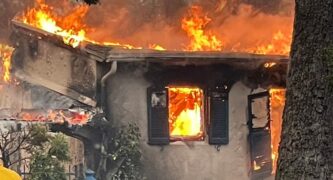

The criminal investigation opens a new front in the legal fallout from the January 7 wildfire that devastated a wide swath of the unincorporated community northwest of Pasadena.
Edison already faces nearly 1,000 civil lawsuits from fire victims and government entities, according to court records. The U.S. Department of Justice filed a separate civil suit against Edison in September. A first bellwether trial is scheduled for January 25, 2027, in Los Angeles Superior Court.
Pedro Pizarro, chief executive of Edison International, told Wall Street analysts during a Wednesday afternoon conference call that the company was cooperating with the District Attorney’s office, according to the Times. Pizarro said he did not know the scope of the investigation.
In its annual 10-K report filed Wednesday with the U.S. Securities and Exchange Commission, the company said it “could be subject to material fines, penalties, or restitution” if the investigation “determined that it failed to comply with applicable laws and regulations.”
Edison said in the filing that it was “not aware of any basis for felony liability with regards to the Eaton Fire.” The company added that any fines or penalties from the fire would not be recoverable from insurance, from the state’s Wildfire Fund, or through electric rates.
The Los Angeles County District Attorney’s office declined to comment, according to the Times.
The official investigation into the cause of the fire has not been released. A leading theory is that a century-old transmission line in Eaton Canyon, which had not carried power for roughly 50 years, was reenergized and sparked the blaze. Edison executives have said they did not remove the idle line because they believed it could be used in the future.
Despite dangerous Santa Ana wind conditions on the night of January 7, Edison decided not to shut down the transmission lines running through Eaton Canyon, the Times reported. Pizarro has said the winds that night did not meet the company’s threshold at the time for turning off the lines.
Pizarro told investors Wednesday that he continued to believe the company had acted as a “reasonable utility operator” before the fire, the Times reported. Under California law, if a utility is determined to have acted reasonably, it can be reimbursed for damages through the state’s Wildfire Fund, which was established in 2019 with approximately $21 billion in capacity.
Edison has also gone on offense. The utility filed cross-complaints in January 2026 naming Los Angeles County, Pasadena Water & Power, five other water agencies, and Southern California Gas, alleging their failures contributed to the deaths and destruction. The City of Pasadena rejected Edison’s claims.
Edison has also launched a compensation program offering payments to fire victims who give up their right to sue.
A criminal prosecution of Edison would not be the first for a California utility over a wildfire. In 2020, Pacific Gas & Electric pleaded guilty to 84 counts of involuntary manslaughter and one felony count of unlawfully starting a fire stemming from the 2018 Camp Fire, which destroyed most of the town of Paradise in Northern California and killed 85 people.
State prosecutors previously investigated the possibility of criminal charges against Edison for the 2018 Woolsey Fire, which killed three people and destroyed more than 1,600 structures in Los Angeles and Ventura counties. In August 2021, the California Department of Justice, then led by Attorney General Rob Bonta, announced it had found insufficient evidence to pursue criminal charges against the utility for that fire, according to the state’s announcement at the time.
The first bellwether trial in the Eaton Fire civil litigation, involving approximately 50 plaintiffs, is set for January 25, 2027, before Los Angeles Superior Court Judge Laura Seigle.
 Get our daily Pasadena newspaper in your email box. Free.
Get all the latest Pasadena news, more than 10 fresh stories daily, 7 days a week at 7 a.m.