






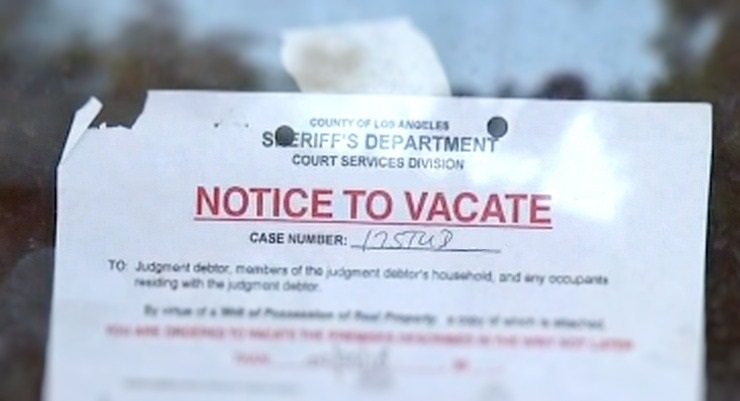
Landlords in Altadena and other unincorporated parts of Los Angeles County will no longer be able to begin eviction proceedings for unpaid rent until a tenant owes more than two months of Fair Market Rent, under an ordinance that takes effect April 16.
The rule doubles the previous one-month threshold. The Board of Supervisors voted 4-1 on March 17 to amend the county’s Rent Stabilization and Tenant Protections Ordinance, which covers rental units in unincorporated areas — collectively home to about 1 million residents, according to Supervisor Janice Hahn’s office. Altadena is unincorporated and falls under the ordinance. Pasadena, an incorporated city with its own rent control laws under Measure H, is not affected.
The eviction threshold is based on Fair Market Rent set annually by the U.S. Department of Housing and Urban Development, not on a tenant’s actual rent. For a one-bedroom unit in the Los Angeles area, HUD’s FY 2026 Fair Market Rent is $2,085. That means a landlord cannot begin eviction proceedings for nonpayment until a tenant owes more than $4,170. For a two-bedroom unit, the FMR is $2,601, setting the new threshold above $5,202.
The change does not forgive unpaid rent. Tenants still owe every dollar, according to the county’s Department of Consumer and Business Affairs, which enforces the ordinance. The department encourages tenants and landlords to negotiate repayment plans and offers free mediation services.
Hahn, who proposed the ordinance with Board Chair Hilda L. Solis, said she expected criticism from both sides.
“This is a modest but necessary increase,” Hahn said in a statement after the vote. “With this additional month, I hope we can give renters some breathing room while not putting the entire burden on landlords who also depend on rental income to pay their own bills.”
Solis, in a separate statement from her office, said the county had taken steps to protect renters in the face of what she described as federal actions affecting immigrant families. She said the threshold increase provides protection against eviction while recognizing that tenants must still repay unpaid rent, according to the press release from Hahn’s office.
Supervisor Kathryn Barger cast the lone dissenting vote. In a statement to City News Service, she said local government should not shift renters’ economic difficulties onto property owners, expressing concern about the burden on smaller landlords who rely on rental income for their retirement and other expenses.
Tenant advocates had pushed for a three-month threshold that would extend beyond unincorporated areas to cities countywide, according to City News Service reporting. That broader proposal did not advance.
Under the ordinance, landlords who serve a Notice of Termination for nonpayment must state the FMR amount and the number of bedrooms, and must provide a copy of the notice to DCBA, which reviews each one to confirm the FMR requirements are met.
The RSTPO covers two categories of rental units in unincorporated LA County: fully covered units, which have both rent caps and eviction protections, and partially covered units — including single-family homes — which have just-cause eviction protections but no rent limits. The eviction threshold change applies to tenants in covered properties.
Altadena renters or landlords with questions can contact DCBA at 800-593-8222 or visit rent.lacounty.gov. The department operates an office at the Altadena Community Center, 730 E. Altadena Drive, open Fridays from 9 a.m. to 5 p.m. Residents can verify whether a property is in an unincorporated area at lavote.net/apps/precinctsmaps. Free legal assistance for tenants facing eviction is available through stayhousedla.org.
The ordinance was first introduced in February and received final approval on March 17. It amends the RSTPO, which the county established to stabilize housing and reduce the risk of homelessness in unincorporated areas. Hahn urged other cities in LA County to adopt their own tenant protection measures.
“While we are taking action today in the communities under our jurisdiction, every city in LA County can put in place their own tenant protection ordinances and I urge them to follow the county’s lead,” Hahn said in the press release from her office.
 Get our daily Pasadena newspaper in your email box. Free.
Get all the latest Pasadena news, more than 10 fresh stories daily, 7 days a week at 7 a.m.