









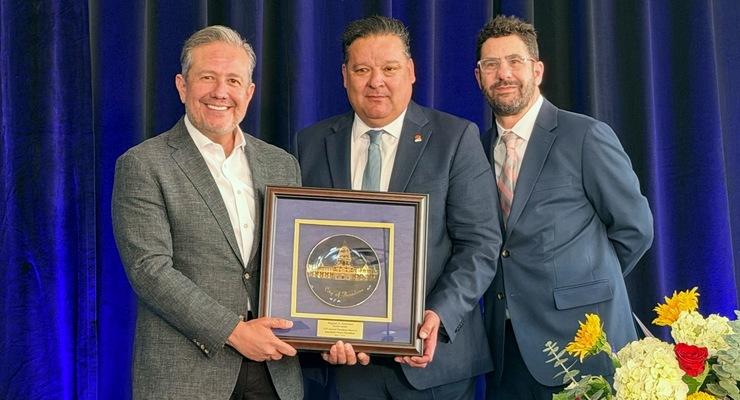
There was coffee, applause, laughter, testimony and, perhaps most notably, a palpable sense of shared endurance.
Held on the National Day of Prayer, the annual gathering brought together clergy members, elected officials, nonprofit leaders and residents from across Pasadena and Altadena under the theme “Rising Together,” a phrase repeated throughout the morning as speakers reflected on a bruising year marked by wildfire recovery, economic uncertainty and continuing homelessness.
The breakfast, hosted this year by Friends In Deed, blended spiritual reflection with a distinctly civic focus, emphasizing practical service and community resilience over doctrinal differences.
“This is Pasadena’s engine,” Pasadena Mayor Victor Gordo told the crowd, gesturing across the packed ballroom. “You’re all the people who do the work.”
Gordo framed the morning less as a ceremonial observance than as a recognition of the people sustaining the community through crisis. He spoke about the importance of preserving “our common humanity” during politically divisive times and urged attendees to “rise together” while also standing together against forces that seek to divide communities.
The emotional center of the morning came from Fiona, a guest of Friends In Deed’s Women’s Room program, who described losing her home and sleeping in her Mini Cooper after suffering financial setbacks that affected both her salon business and housing stability.
She said she discovered the Pasadena nonprofit after asking ChatGPT for help finding services for women in Pasadena.
“I walked in not knowing what to expect,” she told attendees, “but from day one I was welcomed with warmth, kindness and humanity.”
Her remarks drew one of the longest standing ovations of the morning.
Friends In Deed Executive Director Rabbi Joshua Levine Grater used the occasion to highlight the organization’s expanding reach amid growing need. The nonprofit’s food pantry now serves an average of 775 households weekly, while its homelessness prevention program is expected to distribute roughly $450,000 in rental assistance this year.
“If we want to solve homelessness,” Levine Grater said, “the number one thing we can do is not let people become homeless in the first place.”
Keynote speaker Miguel Santana, president and CEO of the California Community Foundation, focused heavily on recovery efforts following the devastating 2025 Eaton Fire and the broader emotional toll still affecting residents months later.
Santana said the foundation distributed more than $100 million in fire recovery aid generated by roughly 50,000 donors worldwide, including grants supporting congregations, mental health programs and community healing initiatives.
But he warned that many families remain deeply vulnerable.
“More than 70 percent of survivors tell us they’re still not home,” Santana said. “Nearly half have exhausted or significantly depleted their savings.”
Throughout the morning, speakers repeatedly returned to themes of solidarity and service, describing faith communities as critical support systems during disaster recovery.
Closing prayers from Christian, Jewish and Baha’i leaders reflected the city’s religious diversity, keeping the focus largely on healing, resilience and mutual care.
As the event concluded, clergy from multiple faith traditions gathered around Gordo near the stage. Attendees joined in song before lingering in conversation at tables decorated with bouquets assembled by guests from the Women’s Room program.
And then speakers and guests walked out into a bright spring morning, no doubt feeling just a little lighter.
 Get our daily Pasadena newspaper in your email box. Free.
Get all the latest Pasadena news, more than 10 fresh stories daily, 7 days a week at 7 a.m.


