











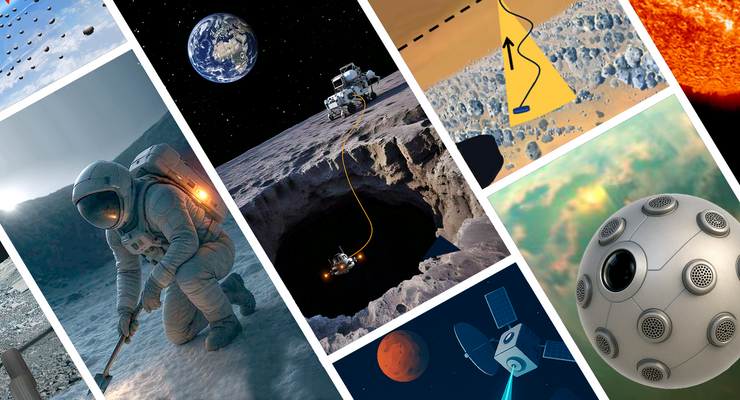
The awards come from the NASA Innovative Advanced Concepts program, known as NIAC, which the announcement described as an innovation incubator funding the early development of potential breakthrough technologies. The announcement said the 18 concepts cover areas ranging from exploration of the solar system to understanding the universe.
The 18 NIAC Phase I awards total $3.2 million. Each provides up to $175,000 for a nine-month initial investigation. The announcement said the NIAC projects are early-stage concept development and are not considered official NASA missions.
The three Pasadena-led concepts
The JPL projects, and the researchers leading them, are:
- Saptarshi Bandyopadhyay, for a concept titled Dimming the Sun Using Controllable Dust Cloud to Reduce Solar Insolation, or DimSun. The announcement listed the potential use of spaceborne dust to reduce solar radiation among the concepts aimed at questions directly related to life on Earth.
- David Bugby, for Combinatory Architecture offering Neomobility, on-Venus Adaptability, and Survivability, or CANVAS. The announcement said Venus, with its hot atmosphere, presents an imposing challenge for research vehicles, and that one awardee is exploring methods of hardening instruments for longer missions there.
- Marco Quadrelli, for Planetary Rings Autonomous EXploration with In-situ Sampling, or PRAXIS. The announcement said two concepts selected this year could help study planetary rings, and that one of them would create a system for collecting samples from rings such as those circling Saturn, Uranus and Neptune.
What NASA said about the program
Greg Stover, director of the Advanced Research and Technology division within the Research and Technology Mission Directorate at NASA Headquarters in Washington, said in the announcement that the agency has outlined an ambitious vision for the future of space exploration — returning to the Moon to stay, advancing to Mars and deepening the understanding of space — and that meeting it will require more than incremental technological advancement. “It means we need great leaps,” he said, adding that the awards represent the kind of innovation the world needs NASA to help foster.
Phillip Williams, NIAC’s acting program executive, said in the same announcement that “every innovation, every leap in technology, starts with a seed of an idea,” and that the program allows NASA to germinate those seeds and determine whether something could be grown to benefit future space missions and the nation’s aerospace economy.
To be eligible, the announcement said, a concept has to be both potentially transformative and potentially feasible to implement eventually. The award recipients, whom the program calls NIAC Fellows, will study their concepts and work out where the difficulties and the openings for further development lie.
The wider field
The other 15 awards went to universities, private companies, NASA’s Ames Research Center and other research organizations across the country.
Several of the concepts address the Moon as NASA and its partners push for a sustained lunar presence. Those include a system to support hovering robots that would explore lava tubes beneath the lunar surface, a method of managing temperatures for small mobile exploration robots, and a way to incorporate radioisotopic heat sources into suits to keep astronauts warm during the Moon’s nearly two-week-long nights.
Others look far beyond the solar system. The announcement said awardees will explore ways to power interstellar spacecraft, map out continents on exoplanets, observe the photon rings around black holes and detect subtle gravitational waves to explain how galaxies formed. Of the two ring concepts, the announcement said, one would use a swarm of 10,000 tiny satellites to map and analyze the rings of Saturn.
A further concept addresses awareness about the debris orbiting Earth, which the announcement grouped with the spaceborne dust proposal as work on questions directly related to life on Earth.
Paul Stankus of Brookhaven Science Associates in Upton, New York, received two of the 18 awards, one for using optical very long baseline interferometry, or VLBI, to image continents on exoplanets and another for a spacecraft-based astrometry method of detecting gravitational waves. Michael Rubenstein of Northwestern University in Chicago was selected for a project on actively steerable femtosat constellations for in-situ exploration of Saturn’s rings, atmosphere and magnetosphere.
Also selected were Zhaoyan Liu of NASA’s Ames Research Center in California’s Silicon Valley; Anish Damodaran of the University of Central Florida in Orlando; Artur Davoyan of the University of California, Los Angeles; Daniel Drew of the University of Hawaii in Honolulu; Keunhan Park of the University of Utah in Salt Lake City; Austin Phoenix of Virginia Polytechnic Institute and State University in Blacksburg, Virginia; David Smith of Duke University in Durham, North Carolina; and Pablo Sobron of the Search for Extraterrestrial Intelligence Institute in Mountain View, California.
Four awards went to researchers at companies: A.C. Charania of Zeno Power Systems, listed as being in Washington; Gilly Elor of Stone Aerospace in Del Valle, Texas; Jeff Nosanov of Orbital Velocity in Decatur, Georgia; and Benjamin Schafer of Rarefied Technologies in Albuquerque, New Mexico.
The full list of 2026 selections is posted at https://www.nasa.gov/
 Get our daily Pasadena newspaper in your email box. Free.
Get all the latest Pasadena news, more than 10 fresh stories daily, 7 days a week at 7 a.m.