





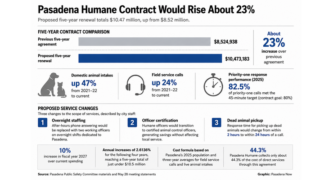

The Pasadena Public Safety Committee on May 28 advanced a proposed five-year, $10,473,183 contract with Pasadena Humane Society, marking a roughly 23% increase over the previous five-year agreement valued at $8,524,938.
Public Health Director Manuel Carmona told the committee the new contract reflects rising direct service costs and a sharp increase in demand for animal services in Pasadena, including a 47% jump in domestic animal intakes from 2021-22 to current and a 24% increase in field service calls.
“Pasadena Humane has been our poundmaster for over 120 years,” Carmona said, requesting authorization to renew the agreement before it expires at the end of June. The current fiscal year value of the existing agreement is $1.8 million.
The contract calls for an approximately 10% increase in fiscal year 2027 over current spending, followed by annual increases of 2.6136% for the remaining four years, building to the total five-year value of just under $10.5 million.
Carmona said the proposal includes three significant changes to the scope of services. After-hours phone answering would be replaced with two working officers on overnight shifts dedicated to Pasadena. Humane officers would transition to certified animal control officers, generating savings without affecting local service. And response time for picking up dead animals would change from within two hours to within 24 hours of a call.
The change in dead animal response time prompted questions from Councilmember Justin Jones, who asked how the shift would affect neighborhood quality of life and public health.
“It’s really a cost saving measure just since we don’t have staff overnight right now,” Carmona said. “Having somebody prioritize picking up a dead animal overnight, it would really just save some money to be able to allow for them to pick it up first thing in the morning or our first possibility when staff are available the next day.”
Captain Jerry Mai, who oversees Pasadena Humane field services, told the committee the agency uses six priority levels for calls, with response targets ranging from 45 minutes to 24 hours. Priority one calls — which include sick or injured animals, animal cruelty cases, and requests from police or fire departments — would continue to be answered within 45 minutes.
In 2025, Pasadena Humane met the priority one response goal 82.5% of the time, exceeding the contract target of 80%, Mai said.
Councilmember Tyron Hampton asked staff to communicate the change to residents who currently expect rapid pickup of deceased animals.
“Pasadena Humane, we have an amazing communications team. I’m sure we’ll be able to share that publicly,” Mai said. “Our dispatchers, when we’re taking in these calls, we are explaining that, ‘Hey, we are going to respond as soon as we can.'”
The standardized cost formula in the proposed contract is calculated based on Pasadena’s 2025 population and three-year averages for field service calls and live animal intakes, Carmona said. He described the formula as an effort to increase transparency and make costs more predictable in out years, while standardizing terms across all cities that contract with Pasadena Humane.
The 10% first-year increase also reflects rising costs to the agency. Carmona said the direct cost of core contractual services has increased an average of 14% per year over the last five years. Pasadena Humane has also experienced an 18% increase in insurance costs, an 11% increase in utility costs and a 21% increase in supply costs over the same period.
Despite the contract value, Pasadena Humane collects only about 44.3% of the cost of direct services through its agreement with the city, Carmona said.
Core services under the contract include animal control and field services, support for animal control hearings, shelter operations, veterinary care and reporting for compliance with state requirements.
Carmona said Pasadena Humane also provides services beyond the contract that the city does not pay for, including Helping Paws, a program providing free pet food, medicine and supplies, subsidized vaccinations, low-cost spay and neuter services, dog training, post-adoption support and humane education. The agency also provides emergency boarding, crisis assistance, wildlife rehabilitation and community education at no cost to the city.
Mai also addressed questions about protective custody holds for animals belonging to residents who are hospitalized or arrested. Under California Penal Code 597.1, Pasadena Humane can take possession of such animals for an initial 10-day period, which can be extended on a case-by-case basis, he said. The agency charges a boarding fee of approximately $15 per day, with medical costs added when animals require treatment.
If the agency cannot reach the owner during the 10-day hold and a subsequent 14-day contact-attempt period required by state law, the animal may be considered abandoned and become the property of Pasadena Humane, after which it may be placed for adoption, sent to a rescue or placed in foster care, Mai said.
Pasadena Humane Executive Director Chris Ramon also attended the meeting.
Carmona told the committee the proposed action is not subject to the California Environmental Quality Act pursuant to code section 21065. Staff recommended that the city council grant the contract an exemption from competitive selection and authorize the city manager to enter into the agreement for a five-year term not to exceed $10,473,183.
Councilmember Hampton moved to forward the item to the full city council. The motion passed without objection.
 Get our daily Pasadena newspaper in your email box. Free.
Get all the latest Pasadena news, more than 10 fresh stories daily, 7 days a week at 7 a.m.