









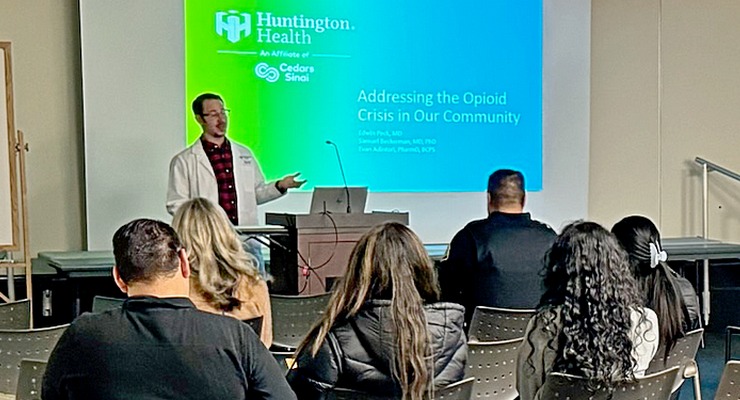
They joined emergency physicians and community outreach nurses and carried opioid overdose training into schools, libraries, community centers, farmers markets and other public venues.
Between 2021 and 2024, the hospital’s opioid overdose education and naloxone distribution program, known as OEND, provided overdose prevention training to 3,466 community members and distributed 517 naloxone kits, according to a study its members published in the American Journal of Health-System Pharmacy.
Expanding beyond the emergency department produced an 84% increase in distribution over emergency department efforts alone, the study reports.
The hospital operates the San Gabriel Valley’s only Level II trauma center. Its earlier public fentanyl seminars ran at three Pasadena branch libraries and at the Altadena Library on East Mariposa Avenue. Huntington Health says the program reached thousands of residents across the San Gabriel Valley and Los Angeles County.
The research paper, “Enhancing opioid overdose education and naloxone distribution through pharmacist-led community outreach,” appeared online March 24, 2026, in the journal’s Frontline Pharmacist section.
The program ran in two phases, according to a news release from Huntington Health, an affiliate of Cedars-Sinai. Emergency department staff first identified patients at high risk of overdose and gave them free naloxone and training before discharge, distributing 281 kits. The team then moved outward, distributing another 236 kits to students, parents, educators, public safety workers, hospital staff and residents. The curriculum was adjusted for each audience but held to the same core messaging: overdose recognition, naloxone administration and emergency response protocols. The researchers described the program as low-risk, highly scalable and adaptable across a wide range of community settings, according to the release.
“Naloxone education is a powerful form of community empowerment,” said Samuel Beckerman, an emergency physician at Huntington Hospital and a co-author of the study, in the release.
Ten clinicians are listed as authors — pharmacists, emergency physicians and community outreach nurses, all affiliated with Huntington, one also with Martin Luther King Community Hospital in Los Angeles. Such programs help address the “bystander effect,” in which individuals may hesitate to intervene during an emergency, and bystander naloxone administration can dramatically improve the likelihood of recovery, according to the release. Pharmacists are uniquely positioned to lead interventions that increase naloxone access and strengthen community readiness, the authors conclude, according to the release.
The team wrote that a decade of rising fentanyl overdoses made the work urgent. Between 2016 and 2022, fentanyl-related deaths in Los Angeles County rose 1,652%, from 109 to 1,910, while related emergency department visits rose 833% and hospitalizations 387%, the study states. County data since then point the other way. Fentanyl deaths fell 37% in 2024, to 1,263, and all drug-related overdose deaths dropped 22%, to 2,438, the lowest total since 2019, according to the county Department of Public Health.
Naloxone is more than 90% effective when given promptly and can be administered by bystanders as well as first responders, the study states.
The full study is at academic.oup.com.
 Get our daily Pasadena newspaper in your email box. Free.
Get all the latest Pasadena news, more than 10 fresh stories daily, 7 days a week at 7 a.m.