








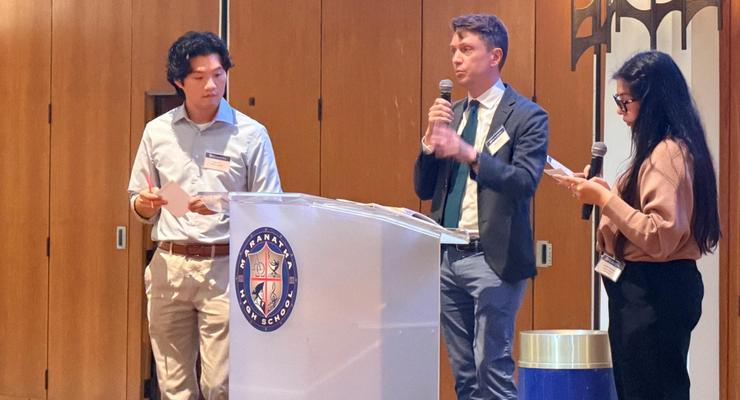
The meeting, the first of two planned listening sessions, held at Maranatha High School, began 20 minutes late. Organizers then spent considerable time on introductions before moving to a short formal presentation and then to questions, which they collected on cards and grouped by subject rather than addressing individually.
For residents already familiar with the traffic problems along Pasadena Avenue and St. John Avenue, the arrangement quickly became a source of irritation.
“You’re just censoring the conversation,” one attendee protested.
Jennifer Velazquez of Chino Hills-based Arellano Associates, the city’s outreach consultants, explained that combining similar questions would allow officials to address more concerns within the allotted 25-minute question period.
“We definitely were leaning more towards this method to try to get through as many as we can,” she told the audience.
The Department of Transportation team, led by principal planner Scott Johnson, included Tina Machado, Alvin Mangazar and Donson Liu.
Johnson outlined a project funded by more than $75 million in Los Angeles County Metropolitan Transportation Authority Measure R grants. The money is intended to pay for roadway improvements, traffic signals, pedestrian crossings, bicycle facilities and related engineering and construction costs.
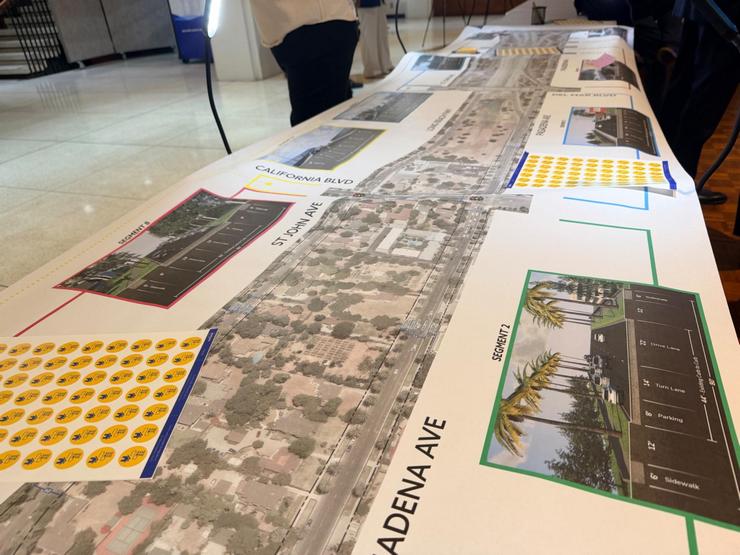
The project covers Pasadena and St. John avenues between Walnut and Columbia streets, an area closely connected to the former 710 Freeway extension and the city’s longer-term plans to reconnect neighborhoods divided by freeway construction.
Johnson emphasized that the current project would not radically alter the roadway network. Officials anticipate maintaining two traffic lanes in each direction while exploring safety improvements.
But several residents wanted action sooner.
“I’ve been asking for that for three years,” one resident said when Johnson discussed possible speed-control measures.
The resident identified St. John Avenue between California Boulevard and Bellefontaine Street as a particular concern.
Another attendee described motorists racing through the neighborhood from the freeway.
“They’re going from the freeway to Bellefontaine like it’s a speedway,” the resident said.
“Someone is going to die and that’s not hyperbole,” the parent said.
Officials acknowledged speeding concerns and said they could address some improvements before the larger project begins construction.
Pete Ewing, a West Pasadena Residents’ Association board member and former vice president who chairs its Planning and Land Use Committee, criticized the meeting afterward.
“They spent 45 minutes on flow and 25 minutes on program questions,” Ewing said, arguing that residents deserved an open exchange in which neighbors could hear one another’s concerns.
“What we want is a dialogue in front of other West Pasadena people so they can understand what’s going on,” he said.
Ewing called the experience “extraordinarily frustrating,” recalling similar difficulties during discussions about the former 710 corridor.
Johnson said approximately 4 percent of the grant would cover design work, with most funding directed toward physical improvements. He said the grant could cover the proposed work.
Afterward, Velazquez acknowledged the criticism and suggested a different format for the next meeting.
“We’re taking all the input that we can,” she said. “This is our first one for this project, so we’re definitely willing to pivot for the next one. We just didn’t want to have to pivot on the spot.”
The city plans to develop design alternatives after gathering public comments, then return to residents for further review.
For neighbors who have spent years asking for safer streets in that West Pasadena neighborhood, Thursday’s meeting suggested that the challenge may extend beyond traffic engineering to whether City Hall can convince residents that their voices are being heard.
 Get our daily Pasadena newspaper in your email box. Free.
Get all the latest Pasadena news, more than 10 fresh stories daily, 7 days a week at 7 a.m.