









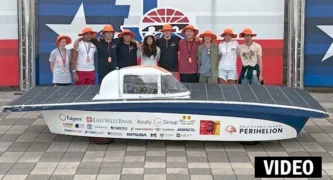
Polytechnic School’s student Solar Car Team has completed its third year of competition in the national Solar Car Challenge, reaching a major milestone as Perihelion, the team’s current vehicle, has now traveled nearly 2,000 miles in sanctioned races since its debut.
After competing on a closed racetrack course in previous years, the students took on a new challenge this summer: drive on public roads across Texas. The 631.7-mile course stretched from Fort Worth to Fort Stockton, pushing teams through rolling hills, extreme heat, and constantly changing road conditions.
“This year was a turning point,” said co-captain and rising senior Arjun Singh. “The car was originally built with a track in mind, but on the road we had to adapt constantly—managing heat, rough pavement, battery temperatures, and strategy in real time.”
Preparing the car for the road required significant engineering upgrades. Students raised the suspension to navigate uneven surfaces, replaced the entire solar array after wear and debris damage, brought the regenerative braking system fully online to recapture energy on downhill stretches, and added forced-air cooling to the high-voltage battery pack to combat triple-digit temperatures.
The race also brought unexpected setbacks. A failed front wheel bearing, a blown fuse, and recurring software issues that shifted the car into neutral forced the team to diagnose problems under pressure. Students rewrote control code and redesigned cooling systems to keep Perihelion in competition.
“After we fixed the bearing, added forced-air cooling, and updated the control software, the car and the team were finally working in perfect sync,” said co-captain and rising senior Ryan Keltner.
Perihelion represents nearly two years of design, fabrication, testing, and certification. Built with a carbon-fiber body over a steel chassis, the car reflects hundreds of hours of work by students, who completed destructive testing of carbon-fiber samples, machined custom steering and axle components, and passed the competition’s rigorous technical inspection process.
“This is a true student initiative,” Singh noted. “But it exists only because our community chose to believe in us and invest in us.”
The Solar Car Challenge also fostered collaboration among competitors. When Poly needed a replacement wheel bearing, another team in its division, the Iron Lions, shared a spare from its own supply, allowing Poly to continue racing.
“That spirit of ‘we all want each other to race’ defines the event,” Singh said. “We’re all there to prove what students can do with the right support and a lot of hard work.”
Poly completed 612.3 miles and finished third in the Advanced Division. The team now hopes to expand its roster by recruiting younger students and has already begun planning its next solar car.
To learn more about the Polytechnic School Solar Car, visit: https://polysolarcar.
To learn more about the Solar Car Challenge, visit: https://www.
 Get our daily Pasadena newspaper in your email box. Free.
Get all the latest Pasadena news, more than 10 fresh stories daily, 7 days a week at 7 a.m.