









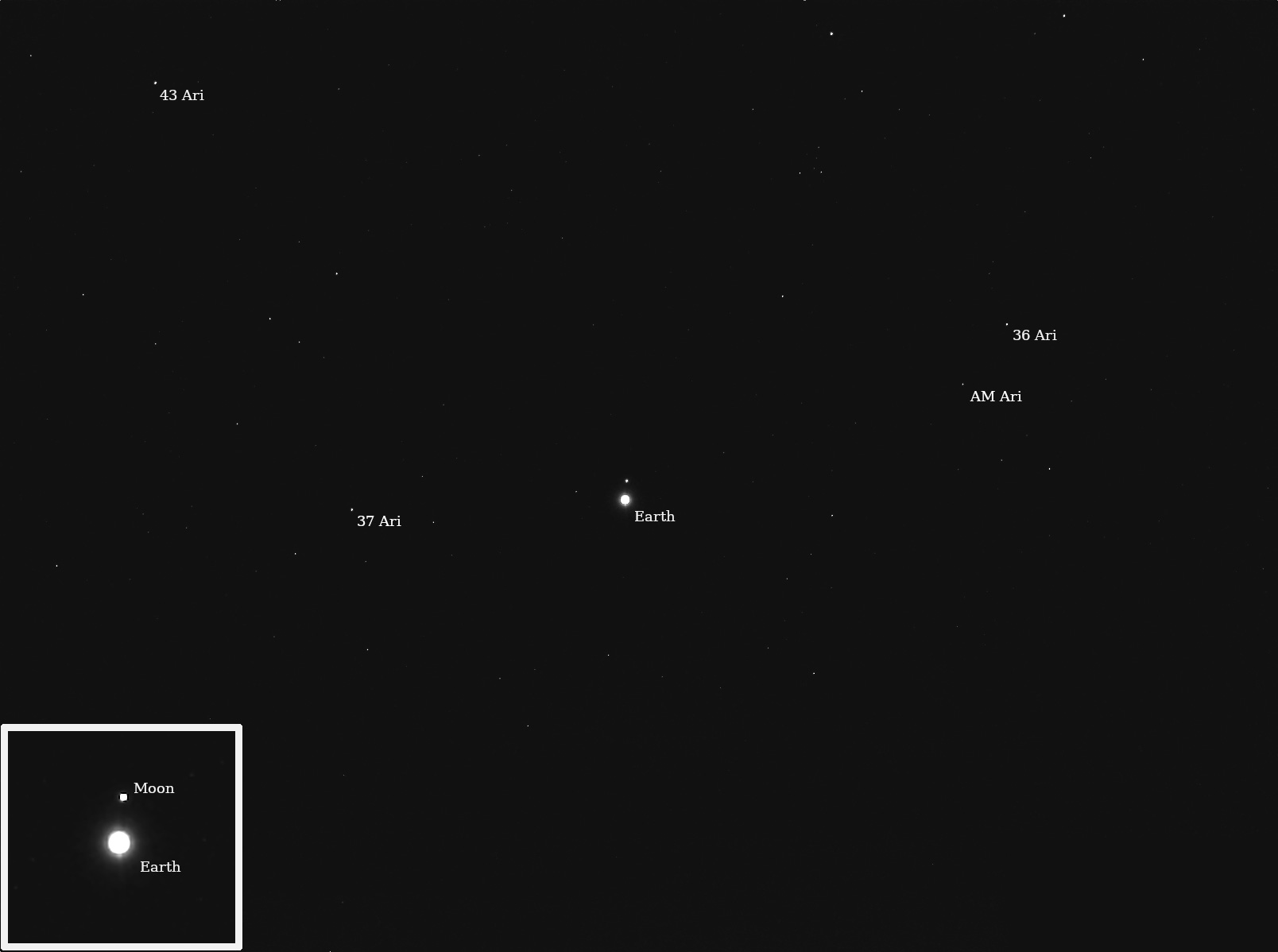
NASA’s Jet Propulsion Laboratory in Pasadena confirmed that the Psyche spacecraft successfully captured images of Earth and the Moon from approximately 180 million miles away during a camera calibration exercise in July, according to a NASA press release.
The long-exposure images, taken on July 20 and 23, show Earth and its satellite as bright specks amid the starfield of the Aries constellation. The calibration was part of a scheduled checkout of the spacecraft’s multispectral imager, which will be used to study the surface of the metal-rich asteroid Psyche upon arrival in 2029.
“We are up and running, and everything is working well,” said Bob Mase, the mission’s project manager at NASA’s Jet Propulsion Laboratory in Southern California. “We’re on target to fly by Mars in May 2026, and we are accomplishing all of our planned activities for cruise.”
JPL oversees the mission’s system engineering, integration, testing, and operations. The spacecraft launched from NASA’s Kennedy Space Center in October 2023 and is currently en route to the asteroid located between Mars and Jupiter. The billion-mile journey includes a gravity assist maneuver around Mars in May 2026, which will slingshot the spacecraft toward its final destination.
The imager instrument, developed in collaboration with Arizona State University and Malin Space Science Systems, uses twin cameras with filters and telescopic lenses to analyze planetary surfaces in various wavelengths. Scientists selected Earth and the Moon for calibration due to their reflective properties and well-documented spectral profiles. Earlier in the year, the spacecraft also calibrated its instruments using Jupiter and Mars, which have more reddish spectra compared to Earth’s bluer tones.
In addition to the imager, the spacecraft’s magnetometer and gamma-ray and neutron spectrometer underwent successful testing in late July, part of a biannual systems check. These instruments will help scientists analyze Psyche’s composition and magnetic properties once in orbit.
The Psyche mission is part of NASA’s Discovery Program, managed by the Marshall Space Flight Center in Alabama. It is led by Arizona State University, with Lindy Elkins-Tanton of the University of California, Berkeley serving as principal investigator. Maxar Technologies in Palo Alto provided the spacecraft’s high-power solar electric propulsion chassis.
JPL’s leadership in the mission continues Pasadena’s legacy of deep space exploration and scientific innovation.
For more information, visit https://science.nasa.gov/mission/psyche.
 Get our daily Pasadena newspaper in your email box. Free.
Get all the latest Pasadena news, more than 10 fresh stories daily, 7 days a week at 7 a.m.