









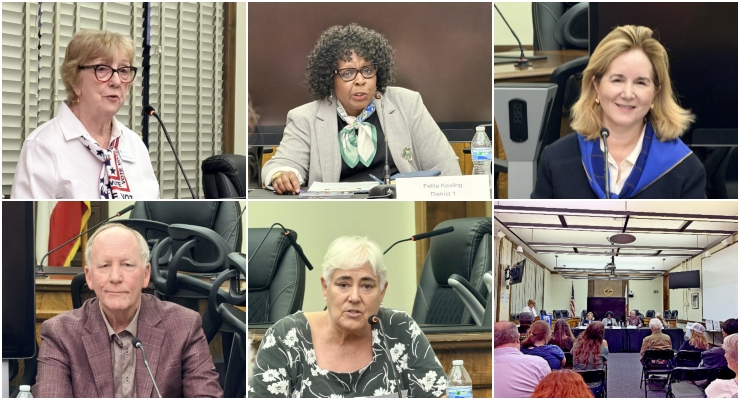
Inside Pasadena Unified School District headquarters on Monday evening, nearly 100 parents, teachers, supporters, and community members packed the small boardroom, filling rows of black chairs and standing along the walls and the back of the room.
At the front, four school board candidates sat shoulder to shoulder behind a long black-draped table, beneath the empty seats of the Board of Education. Microphones and water bottles shared space with handwritten name cards and notes.
The setting was modest. The questions were not.
For more than an hour, candidates for two of the three contested PUSD board seats were asked about declining enrollment, school closures, academic achievement, district finances, bullying, safety and a problem that surfaced repeatedly throughout the evening: trust.
The forum was organized by the Pasadena Education Network with district parent organizations and moderated by Dorothy L. Keane, communications director and Communications Committee chair of the League of Women Voters of the Pasadena Area.
Keane explained that questions submitted by the audience would be combined when they overlapped and broadened when directed at only one candidate.
District 1 incumbent Kimberly Kenne faced challenger Felita Kealing, while District 7 candidates Cynthia Torres and Dennis McNamara sat beside them. District 3 candidates Michelle Richardson Bailey and Veronica Elias did not participate, although statements from both were read.
The most difficult question of the evening was also the most direct: Would the candidates be willing to close schools?
Kenne, who has served on the board since 2011, said she had reached no such decision.
“I believe we need to look at all of our options,” she said.
Kenne recalled the district’s 2019 consolidation process, when officials considered enrollment, capacity and different scenarios before closing campuses. If another such process led to the same conclusion, she said, she would act.
“Yes, I would be willing to make that decision if that’s where we end up,” she said.
Torres, a college counselor who has served 11 years on a financial oversight committee for the Santa Monica-Malibu school district, also said she could vote to close schools.
“Could I do it? Yes, I could. I’m a very pragmatic person,” she said.
But Torres set conditions. The evidence would have to point that way and the community would have to support it, she said, and the district would need an asset management plan for any closed campus rather than leaving sites to sit empty for 20 years. She also cited a Stanford study that, she said, found little evidence that closures save money and suggested they can drive families out of a district.
“If you are student focused, if you’re truly student focused, this kind of decision would give you a lot of pause,” Torres said.
Kealing, a PUSD employee and former president of the Pasadena Educational Foundation board, said she had watched the district close 11 schools over the years and had not seen good results from it.
“I feel ambivalent about closing schools,” she said. But she said she was committed to doing “whatever’s legally, morally and ethically possible to do to make our district better.”
Kealing rejected the idea that there was a single obvious solution.
“It should be strategic, visionary and developed over a period of time with thought leaders, not people who say, ‘This is the way it has to go, it’s either my way or the highway,’ but just really sitting down and sitting back and having those collective conversations,” she said.
McNamara was more urgent.
“Do I get three hours for this one?” he joked when the consolidation question reached him. “This is the million dollar question.”
A retired financial executive and chartered financial analyst, McNamara pointed to enrollment projections, due to be presented that Thursday, showing a district of roughly 13,000 students falling to 10,000, and possibly as low as 8,000.
“That’s not our fault, but it is our reality,” he said.
The danger, he argued, was keeping too many campuses open while stripping them of the programs that make them viable schools.
“We’re hollowing out schools,” McNamara said. “We have, in some cases, no librarians. How do we call this a championship city?”
He said every campus should offer “a top drawer educational experience” with a broad selection of electives and other opportunities. He also acknowledged that he did not know what configuration of schools would ultimately accomplish that.
“I’m not an expert in this,” he said. “No one on the board’s an expert in this, clearly the district’s not an expert in this. So we do need outside input.”
“We don’t want to rush,” he added, “but we got to be quick.”
McNamara also took issue with the Stanford study Torres had cited. He said it found that closures save money in some cases and not in others, and that it did not account for the value of repurposing land or for families who leave the district before any school is closed.
The closure debate grew directly out of an earlier question about money: what safeguards the candidates would put in place to keep PUSD from reaching another fiscal crisis.
McNamara said he was encouraged that the district’s new chief business officer understood that one-time funds should not pay for ongoing operations, calling that practice “a serious misuse of budgeting.” He also endorsed a full audit of the district’s central office, an idea he credited to District 3 candidate Veronica Elias.
“It’s a very opaque world,” he said. “I’d be shocked if there wasn’t a lot of savings associated with overhead here.”
Kenne said unreliable financial forecasting had damaged relations with district employees and argued for greater transparency. Torres proposed creating a financial oversight committee modeled on the one she chaired in Santa Monica-Malibu. Kealing emphasized enrollment and attendance as ways to strengthen district revenue.
But the evening did not remain fixed on balance sheets.
Candidates were pressed about achievement among Black and Latino students and other students of color. They faced questions about bullying and school safety and about how board members could hear directly from students.
Kealing pointed to her experience helping establish the district’s African American Parent Council and stressed cultural competency in the classroom.
“We want them respected and valued in their particular learning environments,” she said of students.
McNamara proposed putting academic progress for every student group near the top of each regular board agenda, rather than discussing it only periodically or late at night.
“Every regular school board meeting has to have an agenda item on academic progress for every group,” he said. “That’s early in the meeting, every regular meeting, not every six months, not at 10 minutes to 11.”
Kenne said targeted state and federal funding needed to reach the students for whom it was intended and called for stronger classroom support. Torres said she wanted greater attention paid to mathematics alongside the district’s work in literacy.
Again and again, though, the discussion returned to trust.
Torres said she had met parents while campaigning who were anxious enough about PUSD’s future to wonder whether their children should remain in the district. She proposed spending the rest of the year listening to the community and holding off on major decisions until then.
Kenne acknowledged how easily confidence can be lost.
“Parents lose trust and lose faith in us when we treat them poorly … when their students don’t have options and are not prepared for the future,” she said.
The theme carried into the closing statements. Kenne told the audience she believes “in transparency and integrity to keep the trust of our stakeholders.” McNamara, acknowledging the urgency and frustration in his answers, ended on a note of optimism.
“We can build our schools back to where they were and build that community trust,” he said.
 Get our daily Pasadena newspaper in your email box. Free.
Get all the latest Pasadena news, more than 10 fresh stories daily, 7 days a week at 7 a.m.