







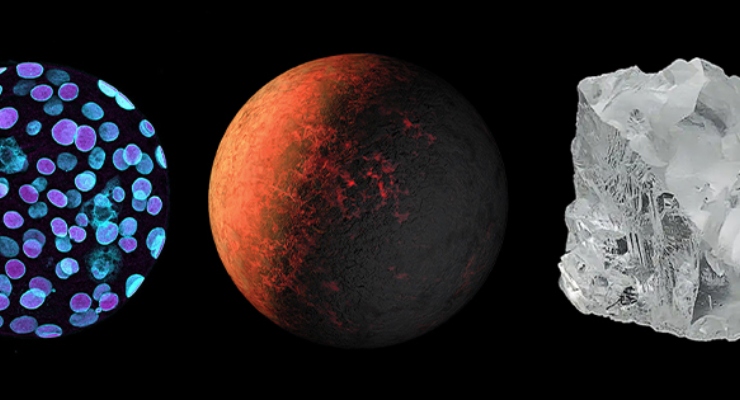
Prof. Evgenya Shkolnik of Arizona State University will examine this possibility on Tuesday, Nov. 11, at Carnegie Observatories in Pasadena. Her talk explores exospace weather, a new field studying how stellar activity affects planets beyond our solar system.
Space weather shapes planetary atmospheres throughout the cosmos. Its effects appear in auroras and comet tails. It gradually strips away atmospheric layers.
Scientists are just beginning to understand its impact on exoplanets.
Stellar flares, particle winds and coronal mass ejections could reshape exoplanet climates. They may drive atmospheric escape. These forces might even determine if a planet can sustain life.
The field sits at the crossroads of heliophysics, stellar physics, planetary science and astrobiology.
Prof. Shkolnik leads the SPARCS mission, a cereal-box-sized space telescope that monitors flares and sunspot activity on low-mass stars. It measures ultraviolet radiation to assess how habitable the space environment is for orbiting planets.
JPL in Pasadena was responsible for developing the ultraviolet-optimized camera and advanced detectors for the SPARCS project.
The research draws from work supported by the W. M. Keck Institute for Space Studies. Shkolnik will discuss what scientists know about stellar winds, flares and ejections. She’ll also explore how future observatories could forecast space weather on distant exoplanets.
Her current research includes studying star-planet interactions and identifying young M dwarf stars in the solar neighborhood. She investigates how high-energy stellar radiation affects planetary formation and evolution.
The colloquium runs from 11 a.m. to noon at the William T. Golden Auditorium, 813 Santa Barbara Street. Carnegie Observatories hosts the event.
Remote viewing is available via Zoom. To register, visit https://carnegiescience.edu/
 Get our daily Pasadena newspaper in your email box. Free.
Get all the latest Pasadena news, more than 10 fresh stories daily, 7 days a week at 7 a.m.