






“This year the dogs of Madison Heights are the grand marshal of the parade,” said Jason Lyon, the District 7 councilmember, who plans to walk the route with his own dog, Douglas.
The scene repeats, in its own key, across the city. In the Historic Highlands neighborhood, Rick Cole — the District 2 councilmember and a former Pasadena city manager — will join the neighborhood parade he calls his favorite tradition.
“It is simple, heartfelt and genuine,” Cole said. “The Boy Scouts host the colors, new and old friends march around the block and everyone gathers for a potluck picnic in the street. That’s Pasadena, that’s Americana.”
In Northwest Pasadena, Tyron Hampton, the District 1 councilmember, will spend the day on foot. “I will visit as many block parties and eat as much barbecue and other side dishes that I possibly can,” Hampton said, “until I’m like, ‘Man, full.'”
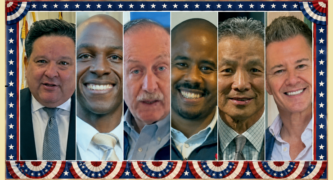
The United States turns 250 on Saturday, July 4, 2026. Pasadena Now interviewed Mayor Victor Gordo and five members of the Pasadena City Council about what the milestone means for the city, and on one point they were unanimous: Pasadena celebrates the nation’s birthday neighborhood by neighborhood, block by block. Asked which Fourth of July traditions mean the most in his district, Hampton needed just two words: “Block parties.”
The pattern holds even where the block party does not. Gene Masuda, the District 4 councilmember, said he hears of no Fourth of July block parties in his East Pasadena district, but he described a holiday stitched from the same material: backyard barbecues, family picnics in the parks, and a busy morning at the Pasadena Farmer’s Market, which runs from 8 a.m. to 12:30 p.m. on Saturday, July 4.
That neighborhood-scale Fourth carries more weight this year, because the city’s biggest public celebration has been remade. The Rose Bowl has traded AmericaFest and the large fireworks display that for decades drew tens of thousands of spectators for the Foodieland festival and a drone show.
Gordo urged residents to attend the Foodieland event and drone show, and said he considers the Rose Bowl events and the neighborhood block parties, taken together, the citywide celebration. He also opened a door to something more. “I would like to see a 4th of July parade or other events,” the mayor said. “I think that would be fun and people would enjoy it.”
Hampton, whose district includes the Arroyo Seco and the Rose Bowl, said the changes to the July 4 programming reflect new values. “As we are more conscious of our environment, conscious of our air quality, some things do have to change,” he said. “But the one thing that should always stay constant is us coming together and celebrating our freedoms.”
Lyon offered the clearest theory of why the small-scale Fourth matters now. “We’ve had all these cultural changes in the last 20 or 25 years where we work from home more and we get things delivered, so we’re not together in the ways that we used to be,” he said. “Neighborhood gatherings and community gatherings bring us together and remind us that we’re all human beings and all kind of in this together.”
Where the six leaders part ways is on the register of the milestone itself — how much of the nation’s 250th should be celebration, and how much reckoning.
Gordo struck the most celebratory note.
“It’s important to keep in mind the many people who have sacrificed over 200 years to ensure that we live in the greatest country in the world,” he said, adding that Americans “should use this opportunity to recommit ourselves to never repeat some of the mistakes made over the course of 250 years.”
For Masuda, the day is personal. He will begin it by hanging the American flag that then-Congressman Adam Schiff sent him — a flag flown over the United States Capitol to honor his son’s achievement of Eagle Scout rank — and will mark his 42nd wedding anniversary “thinking about how blessed we are to live in this fabulous city of Pasadena.”
Justin Jones, the District 3 councilmember whose district includes Robinson Park, set the holiday beside Juneteenth. The historical plaque honoring Jackie and Mack Robinson, he noted, intentionally highlights their mother, Mallie Robinson, who “raised her children with an unbreakable sense of dignity.”
The Fourth, Jones said, “marks the birth of a radical blueprint for liberty, but democracy is fragile. It is not a given. It has to be protected. If the Fourth is the promise of what we can be, Juneteenth is the reminder of the grueling, generational work it takes to make that promise real for everyone.”
Cole went furthest. As a young councilmember, he co-chaired the effort to save the city’s annual fireworks show; now he sees the anniversary in a graver light. “The nation’s 250th birthday is not a time for gaudy celebrations, but for sober reflection,” he said. “Our democracy is under severe strain and the animating principle of equality under the law is under direct threat.” He invoked Abraham Lincoln’s “unfinished work” of ensuring that government of the people, by the people and for the people shall not perish from the earth.
Yet beneath the differences in tone runs a shared conviction: the republic is maintained, not inherited, and the maintenance happens close to home.
“Democracy is not a spectator sport,” Jones said, pointing to the city’s Public Works and Pasadena Water and Power crews “who show up every single day, rain or shine” as the place where “the American experiment is tested and proven.” Cole defined self-government as “dedicating a part of everyone’s life to leaving our city and our nation better than we found it.”
Hampton reached for family. The Fourth, he said, teaches young people “that we’re all a part of this really big collective family called Pasadena.” And he offered his own benediction: “To the city of Pasadena, I pray that everybody has a wonderful and safe 4th of July.”
Then, presumably, he will start walking.
[Editor’s note: Pasadena Now reached out to Vice Mayor Jess Rivas and Councilmember Steve Madison for inclusion in this article, but neither was available.]
 Get our daily Pasadena newspaper in your email box. Free.
Get all the latest Pasadena news, more than 10 fresh stories daily, 7 days a week at 7 a.m.