








As Americans prepare to mark the nation’s 250th anniversary on July 4, the Thomas Paine Society is hosting an unusual town hall on July 5 at Castle Green, the 1898 landmark where the organization has been based for three decades. The event will feature a British actor playing Thomas Paine in direct dialogue with the audience, inviting Pasadenans to grapple with a historical question that historians have long debated: How much did Paine actually shape the Declaration of Independence?
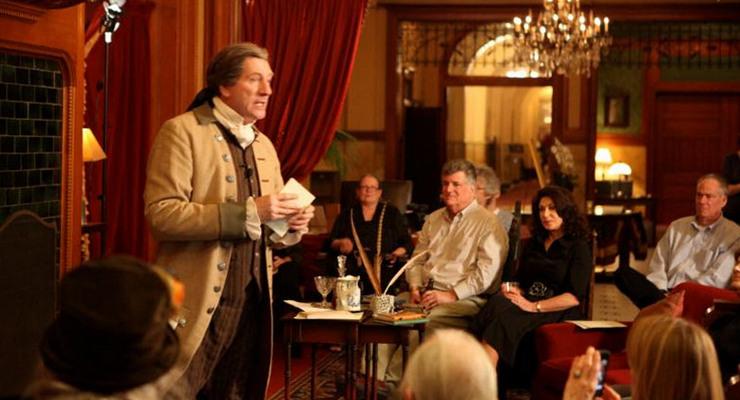
The society has spent 33 years arguing that Paine’s contributions to the founding were historically overlooked. On July 5, from 3 to 5 p.m. at the historic Moorish Revival building, the group will press that case with actor Ian Ruskin, a RADA-trained performer whose one-man play about Paine was filmed by Haskell Wexler and broadcast on PBS. Attendees can purchase tickets for $20 (or $15 for seniors and students) and pose questions directly to “Paine” —who will respond in character.
“Thomas Paine was very essential to the Declaration,” said Alaine Lowell, the society’s executive director, in a recent interview. “Six months before the declaration was written, he wrote Common Sense, and this was the bestseller of the day. It really caused the citizens to rise up and believe that they could fight for liberation. Some people even believe he had a hand in actually writing the [Declaration of Independence].”
Lowell notes that the event builds on the society’s documentary project, currently in development, which aims to advance the historical case for Paine’s Declaration role. The nonprofit has been actively fundraising for this work and plans to showcase it as part of the 250th commemoration.
But the scholarly consensus on this question differs sharply from the society’s framing. Historians credit Thomas Jefferson as the principal author of the Declaration of Independence, drafted by the Committee of Five (Jefferson, Benjamin Franklin, John Adams, Roger Sherman, and Robert R. Livingston).
While scholars acknowledge that Paine’s Common Sense “catalyzed the call for independence from Great Britain,” the evidence of Paine’s direct role in drafting the Declaration itself remains disputed.
“The pamphlet probably had little direct influence on the Continental Congress’ decision to issue a Declaration of Independence, since that body was more concerned with how declaring independence would affect the war effort,” according to mainstream historical scholarship. “While there is no historical record of Paine’s involvement in drafting the Declaration of Independence, some scholars of Early American History have suspected his involvement.”
The society points to a cryptic notation—”Copied with T.P.’s permission”—that appeared on an early draft of the Declaration in John Adams’ handwriting, which they argue may reference Thomas Paine. However, the meaning and significance of this notation remain unclear, and the original draft that Adams referenced is presumed to be lost or destroyed.
Why does Paine remain so little known to most Americans?
Lowell suggests that Paine’s later writings, particularly The Age of Reason (which critiqued organized Christianity) and his unpopular positions on other issues made him a target of historical erasure.
“There was a lot of controversy about his Age of Reason, which was a critique of the Bible,” she said. “That caused a lot of dissent about Paine in certain sections. This was something that was used against him.”
Paine died in 1809 with little fanfare—only six mourners attended his funeral. He had become a polarizing figure, alienated from former allies, and attacked by religious conservatives and political enemies alike. Yet his influence on American democratic thought persisted, and he remains a touchstone for those who see radical equality as central to the nation’s founding ideals.
Ruskin has spent more than a decade embodying Paine on stage and on film. The interactive format of the July 5 event, Lowell explained, is deliberate.
“The audience is able to actually ask questions of Thomas Paine and Ian will answer it as Thomas Paine—what Thomas Paine would say,” she said. It’s an interactive format that allows people to engage directly with someone versed in the founders’ ideas and language.
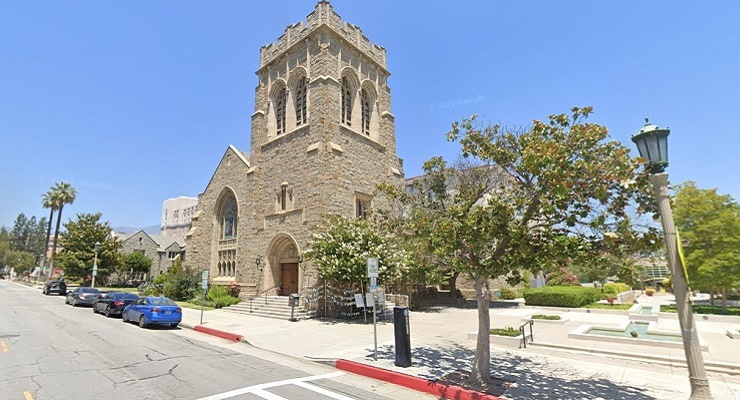
Castle Green itself carries historical weight. Built in 1898 as the Central Annex of the Hotel Green, the building was designed by architect Frederick L. Roehrig and formally opened January 16, 1899. It was added to the National Register of Historic Places in 1982. The building now houses residential units, but its public spaces and gardens are available for rental—which is how the Thomas Paine Society is able to host the town hall.
The July 5 event marks one of many local initiatives across the country taking shape during the nation’s Semiquincentennial year. Pasadena’s Thomas Paine Society has positioned itself as a voice for a particular interpretation of that history: one in which an ordinary man’s clarity of language and radical vision were powerful enough to move a revolution—and worthy of remembrance.
Thomas Paine’s Declaration of Independence Town Hall, part of the 250th Anniversary of the Declaration of Independence, will be held Sunday, July 5, 2026, from 3 to 5 p.m. at Historic Castle Green, 99 S. Raymond Avenue, Pasadena. Tickets cost $20 per person and $15 for seniors and students. Guests can expect open discussion, historical reflection, and a lively exchange with Thomas Paine as portrayed by Ian Ruskin. Parking is available near Castle Green in surrounding public lots and paid structures along Raymond Avenue and Green Street. For more details, visit: https://www.
 Get our daily Pasadena newspaper in your email box. Free.
Get all the latest Pasadena news, more than 10 fresh stories daily, 7 days a week at 7 a.m.