






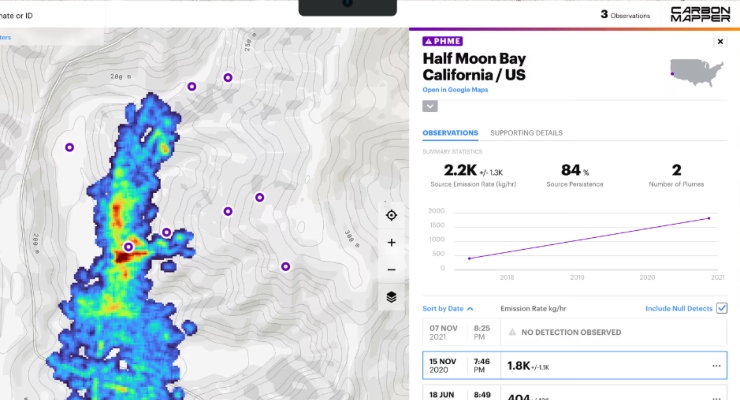
Carbon Mapper announced April 30 that it plans to deploy a next-generation spectrometer on aircraft beginning in late 2027 and on a new satellite as early as 2028, according to a press release from the organization. The instrument, called the Advanced Emissions Monitoring Imaging Spectrometer, or AEMIS, was developed with NASA’s Jet Propulsion Laboratory in Pasadena.
The effort builds on the partnership’s Tanager-1 satellite, launched in August 2024 with Planet Labs. That satellite has since identified more than 11,000 methane super-emitters worldwide, the organization said.
Methane has driven roughly 30% of global warming since the pre-industrial era, according to the International Energy Agency. It lingers in the atmosphere for about 12 years — a fraction of carbon dioxide’s lifespan — making rapid reductions one of the fastest ways to slow warming.
“There is global urgency to pull the emergency brake on methane — a climate-warming super-pollutant — within this decade,” Carbon Mapper CEO Riley Duren said in the release.
The aircraft-mounted AEMIS will detect methane sources as small as 5 kilograms per hour and map emissions at resolutions of one to five meters — fine enough to identify individual pieces of equipment, the organization said. It will also measure carbon dioxide, carbon monoxide, ethane, and ammonia. Initial operations will target livestock emissions and U.S. oil- and gas-producing regions.
Planet plans to integrate the same technology into a specialized satellite designed to cover five times the area of Tanager-1 at 30-meter resolution, doubling sensitivity to methane super-emitters, according to the release.
“Our group at Caltech has spent the past few years working with Carbon Mapper on the science and technology case for pushing to finer spatial scales,” Caltech’s Christian Frankenberg, Chandler Family Professor of Environmental Science and Engineering, said in the release.
Carbon Mapper, headquartered in Pasadena, publishes its emissions data at data.carbonmapper.org.
 Get our daily Pasadena newspaper in your email box. Free.
Get all the latest Pasadena news, more than 10 fresh stories daily, 7 days a week at 7 a.m.