






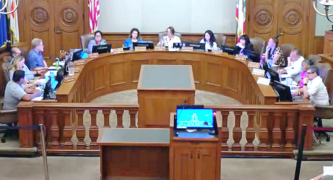

Pasadena’s first public list of rental-registry holdouts — built from 583 properties that had not registered as of June 30, among them a city-owned property a board member identified as senior housing and eight properties tied to a state housing authority — is headed to a City Council committee after a divided Rental Housing Board review Thursday night.
The list, attached to the board’s second-quarter report covering April through June, is the first produced under a June 4 rule change requiring owners who ignore repeated registration notices to be identified by name and property address in the board’s quarterly report to the council as “egregious” cases and actors engaging with the board “in bad faith.”
Rent Stabilization Department Executive Director Helen Morales said she expects to take the report first to the council’s Housing, Homelessness and Planning Committee.
“I will be talking to [Acting Assistant City Manager for the City of Pasadena] Jennifer Paige who manages the HHPC and we’ll try to get in as soon as possible,” Morales said.
The first- and second-quarter reports will go to the council together, she said.
Whether the list then reaches the full council, and whether as an information or consent item, will depend on direction from the city manager, Morales said, though she noted the charter says the reports go “to city council.”
No date has been set. Morales agreed, at board member Ryan Bell’s request, to email each board member once the committee hearing is scheduled. The board took no vote Thursday; the report was an information item.
The city’s own property
Among the 531 entries in the attachment — 16 pages of listings, some of them individual units at the same address — is 762 N. Fair Oaks Ave., listed with the owner name “Pasadena City.” Board member Emanuel “Manny” Najera, who represents District 1, identified it as the senior housing at Orange Grove Boulevard and Fair Oaks Avenue.
“One thing I did find shocking was that the city of Pasadena is not compliant with Measure H. How is that possible?” Najera said.
The city does own the property but leases it to a nonprofit that is required to register and has not, Morales explained. She did not name the operator.
If it is a senior citizen property, it is exempt from the registry, said Sophia Vaughn, the department’s rental registry program manager, but “we just need to have the people who are managing that property to come and let us know.”
Eight more addresses — 231 S. De Lacey Ave., 177 N. Hudson Ave., 678 E. Walnut St., 153 W. Dayton St., 132 and 168 W. Green St., 175 Valley St. and 289 N. El Molino Ave. — are listed under the CSCDA Community Improvement Authority, which Bell described as “a state agency that is in charge of supposedly affordable workforce housing and they have apparently not cooperated with the department.” Its presence on the list, he said, “is actually more embarrassing than most of the rest of them.”
“It’s not just like last week we tried to reach them, but for two and a half years we’ve been trying to reach them or two years or whatever it’s been,” Bell said. “Maybe they are exempt and maybe they’re not. We don’t know, but they at least need to try to tell us what’s going on.”
“These are not mistakes. CSCDA is not a mistake,” Morales said. “We’ve worked with them, we’ve tried working with them and they know of their requirement to register and they have not registered.”
From letters to naming — and toward liens
The list marks the department’s shift from correspondence to public identification. Every property on it reportedly received a registration letter Sept. 1, 2025, followed by email and phone outreach where contact information was available, an initial notice of noncompliance Jan. 16 and a second notice March 27, according to the staff report.
Owners whose noncompliance letters came back undeliverable were left off, as the June 4 amendment to the board’s Chapter 3 regulations requires.
Liens are the next step under discussion.
“We’re considering putting liens on these properties,” Bell said, and “that’s much more drastic than just being on a list that says these people haven’t registered.”
Alternate board member Peter Dreier said the board discussed liens when it set its priorities last month and “I hope we can have a conversation about what it would mean to put a lien on these properties, and that would be a priority for conversation.”
Board member David Coher suggested working with code enforcement to start with the properties carrying the most units, “so we can hopefully start moving that process forward to start moving towards liens.”
The priorities the board set at its Aug. 20 meeting, as recorded in the report, include training the board on legal action against so-called ‘bad actors’ and adding LLC information to the registry, both already in process.
Bell also asked that a future agenda take up widening the “egregious” definition, which the board limited to registry compliance, to other kinds of cases; Morales said that is already on the department’s list.
The money at stake, according to the report: $218,008 in unpaid registration fees and $106,528 in unpaid late fees for the 2025 registration cycle, against $5,930,960 in registration fees and $135,493 in late fees paid.
Late fees go to the city’s general fund rather than to the department, Morales confirmed; Henry said some board members would like to see them redirected to the department, and Bell observed that “not only have we not cost the city any money, we’re actually funding the general fund through late fees.”
The unpaid registration fees are “money that we use for operations,” Dreier said.
The registry, by the numbers
As of June 30, 6,708 of the city’s 7,485 registry properties had completed registration, a 90% rate, and 92% were in substantial compliance counting pending payments and exemptions, according to the report.
The 2025 cycle closed last month at 93%, with 26,494 units registered, Vaughn said; the department had collected $6,066,453 for the cycle as of June 30.
The third cycle opened Sept. 1 with a five-step online process and a new eCheck option, and three days in, registrations had matched what took three weeks a year ago, Vaughn said.
The department has moved payment processing from PayPal to Payroc; Henry said PayPal transaction fees had run about $185,000.
Also in the second quarter: 306 notices were filed through the department’s eviction portal, most of them three-day notices for nonpayment of rent and most from District 3; eight petitions were filed with the hearings division; the board heard four appeals, each upholding the hearing officer’s determination, one with a partial remand; and housing counselors fielded 693 inquiries. Henry flagged a “huge uptick” in three-day notices in District 3 that staff could not immediately explain.
The full report and the attached list are posted with the agenda at https://www.cityofpasadena.
 Get our daily Pasadena newspaper in your email box. Free.
Get all the latest Pasadena news, more than 10 fresh stories daily, 7 days a week at 7 a.m.