



On Tuesday evening, Pasadena’s Recreation and Parks Commission will consider whether to give him something he never received in his lifetime: a permanent memorial in the city he called home.
The proposal comes from William Paparian, a former Pasadena mayor and Marine, who has offered to personally fund the installation of a memorial plaque at Victory Park. City staff has recommended approval, finding the request consistent with the city’s Public Monument Policy.
Harvey, who died in 1996 at age 76, ranks among the most highly decorated soldiers in United States Army history. His awards include the Medal of Honor, the Distinguished Service Cross, three Silver Stars, three Bronze Stars with “V” device for valor, three Purple Hearts, and the French Croix de Guerre with Palm.
Yet despite his deep ties to Pasadena—and despite the city honoring him as Man of the Year in 1952—no permanent marker exists in the city to commemorate his service.
A Pasadena Beginning
Harvey was born in Ford City, Pennsylvania, in 1920 and raised in Sulphur, Oklahoma. He moved to Pasadena, where his foster parents owned a local music store, before enlisting in the Army on August 16, 1939.
His timing placed him at the center of the twentieth century’s defining conflicts. He landed in Normandy one week after D-Day with the 79th Infantry Division and fought across northern France and Germany until the Nazi surrender. His actions during that campaign earned him the Distinguished Service Cross for extraordinary heroism—making him one of a small number of American soldiers who would go on to earn both that decoration and the Medal of Honor.
When war came again in Korea, Harvey was there. He landed at Inchon in September 1950 with the 7th Infantry Division and soon took command of Company C, 17th Infantry Regiment.
“Above and Beyond the Call of Duty”
On the morning of March 9, 1951, Harvey’s company found itself pinned down by heavy machine-gun fire on Hill 1232 near Taemi-Dong. Multiple enemy emplacements had his men trapped, and the mission was in jeopardy.
What happened next earned Harvey the Medal of Honor.
According to his official citation, Harvey advanced alone through automatic weapons fire and exploding grenades to reach the first enemy machine-gun nest, killing its crew. Though wounded, he pressed forward, neutralizing a second and third position. When he spotted a pillbox disguised with logs, he charged it and killed the five enemy soldiers inside with carbine fire and grenades.
He refused evacuation until the objective was secured.
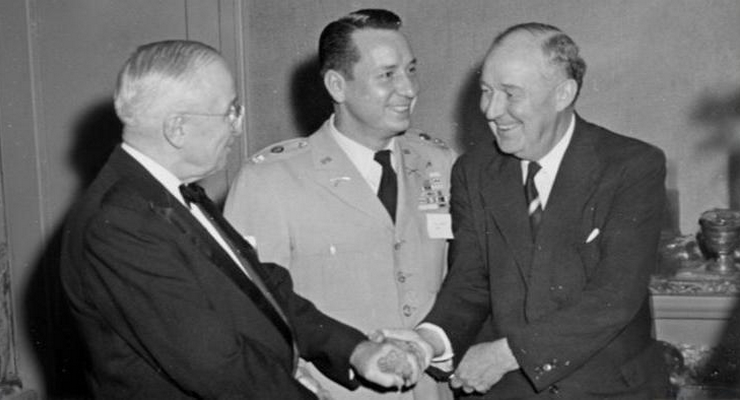
Four months later, on July 5, 1951, President Truman presented Harvey with the Medal of Honor at the White House. Harvey’s foster parents, the Pasadena music store owners who had raised him, were there to witness it.
According to historical accounts, Truman told the recipients they were the backbone of the government and the reason America would win the Cold War. The president then added that he would rather have the Medal of Honor than be president.
Coming Home to Pasadena
Harvey’s return to Pasadena was triumphant. On January 1, 1952, he rode down Colorado Boulevard as one of seven Medal of Honor recipients serving collectively as Grand Marshals of the Rose Parade—the largest group of Grand Marshals in the event’s history. The parade theme that year was “Dreams of the Future.”
That same year, the Pasadena Junior Chamber of Commerce named him Man of the Year. He built a home on Tropical Avenue in the Upper Hastings Ranch neighborhood, putting down roots in the city that had shaped him.
Harvey retired from the Army as a Lieutenant Colonel in 1962. He went on to work for Northrop Corporation and later served as Director of Indian Affairs for the Arizona Division of Emergency Services, a role he held until a stroke forced his retirement in 1981.
He also maintained an unexpected Hollywood connection.
While in the Army Reserves, Harvey served as a technical advisor to the legendary director Samuel Fuller on the Korean War film “Fixed Bayonets!” The two became close friends, and Harvey later advised on Fuller’s “Verboten!” and traveled with the director to Europe to scout locations for “The Big Red One.”
Harvey died on November 18, 1996, in Scottsdale, Arizona. He is buried at Arlington National Cemetery.
A Marine’s Tribute
The plaque proposal before the commission on Tuesday reflects one veteran honoring another. Paparian, a U.S. Marine even before his career in Pasadena politics, submitted the request in November.
Under the terms of his proposal, there would be no cost to the city—Paparian has committed to personally paying all expenses related to the memorial.
Victory Park, the proposed location, would provide an appropriate setting for honoring a soldier whose life embodied the qualities the park’s name suggests.
The Recreation and Parks Commission meets Tuesday, December 2 at 6:00 p.m.
If approved, Raymond G. Harvey—the Pasadena enlistee who became one of America’s most decorated soldiers, who rode as Grand Marshal and was named Man of the Year, who built his home in Upper Hastings Ranch and never forgot where he came from—will finally have a permanent place in the city’s landscape.
Seventy-three years after he helped lead the Rose Parade, his city may finally return the honor.
 Get our daily Pasadena newspaper in your email box. Free.
Get all the latest Pasadena news, more than 10 fresh stories daily, 7 days a week at 7 a.m.