




The ceremonial and introductory matters unfolded before the Council turned to a lengthy agenda on housing, transportation, budget issues and public hearings.
The meeting also ended with Councilmember Rick Cole asking the Council to observe a moment of silence for victims of a deadly shooting earlier that day at the Islamic Center of San Diego.
Mayor Victor Gordo began the ceremonial portion by saying the Council had “three proclamations and certificates of recognition,” starting with the Outspoken Dance Company Elite Team. The team was honored for competing in the 2026 SHARP International Las Vegas Nationals and bringing back one first-place trophy and one third-place trophy to Pasadena.
Gordo praised the dancers for “your dedication, your commitment, your preparation, and your success,” and thanked them for representing Pasadena well. A representative for the team said the dancers were “really happy to be here” and added, “Thank you so much for this amazing award and we can’t wait to win again.”
Councilmember Justin Jones also recognized Coach Jasmine Fennell, saying she and her team had reached out to be acknowledged at the meeting. Jones said it was “imperative” to recognize Fennell’s work “pouring into young people in our community for a positive impact on the city of Pasadena.”
The Council then turned to gun violence awareness, presenting a certificate in recognition of Gun Violence Awareness Day and Month. Gordo said gun violence had affected Pasadena neighborhoods as well as communities across the region, state, country and world. He urged responsible firearm ownership, including secure storage, training and precautions, and said unlawful weapons remained a concern.
“If you have a weapon that’s not registered, please turn it into our Pasadena Police Department who will accept it without questions,” Gordo said.
Lola Osborne, who helped present the recognition, said National Gun Awareness Day is June 5 and Wear Orange Weekend runs June 5-7. She said the City would provide orange ribbons to local community centers to show support for efforts to reduce gun-related crimes and honor those lost to gun violence. A commemorative banner at Robinson Park Recreation Center will allow people to write the names of loved ones and survivors.
Moms Demand Action from Santa Clarita attended in support of the City’s effort.
Senior pastor Kerwin Manning of Pasadena Church accepted the proclamation after Osborne introduced him.
Manning opened by quoting Jeremiah 29:7: “Do good things for the city I sent you to. Pray to the Lord for the city that you are living in because if there is peace in that city, you will have peace also.”
Manning said he had spent 25 years serving more than 178,895 residents in the Pasadena community. He said he had led “the CCC” on issues including affordable housing, nurses’ and workers’ rights, Eaton Fire distribution and gun violence intervention and prevention. He also described his work as “this ministry of presence,” saying he believed “showing up is half of the battle.”
Manning thanked the City for “programs like GOVIS” and “numerous plans, activities,” as well as the police chief and command staff for efforts to remove unregistered and illegal guns from city streets and promote “a safe and sustainable and peaceful Pasadena.” He closed by saying,”God bless you. We are praying for you and we’re praying for our community.”
City of Pasadena Deputy Chief of Police Arthur Chute said officers would wear ribbons June 5-7 for Gun Awareness Weekend. The representative said the department seized or collected 297 firearms in 2025 “thanks to the [vigilance] of concerned community members and proactive police work.”
Chute also said gun safety tips are available on the department’s website under the community and safety dropdown and the divisions and sections dropdown.
Chute said the Pasadena Public Health Department had distributed 45 gun locks since launching a free gun-lock distribution program in November 2025.
“Gunlocks are a preventable measure offering a safe way to store firearms at home,” Chute said. Free gun locks remain available to Pasadena residents at the Public Health Department and select libraries, and Council members had been provided an information sheet on those locations.
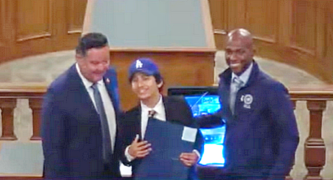
The Council next recognized Zacky Muñoz, a Pasadena youth advocate for food allergy safety, during Food Allergy Awareness Month. Hampton said the recognition had initially been planned for another night, but the Council moved forward after noting that Muñoz’s family had a videographer present.
Gordo said Muñoz had advocated on three major California issues and laws: Zacky’s Bill of 2022, which created the state’s food allergy online resource guide to give schools and families clear and accessible information; the Muñoz SAFE Act of 2023, which strengthened communication, expanded access to epinephrine and allowed after-school providers to receive allergy response training; and Zacky’s FAST Act, which updated California code to reflect current allergy treatment and emergency response practices.
Muñoz thanked the Council and specifically Hampton, who initiated the recognition.
“Being recognized here in the city of Pasadena, the city I call home makes this moment especially incredible,” Muñoz said.
Muñoz said his advocacy began with his own experience living with food allergies but became broader as he understood allergic disease as a public health issue affecting families, teachers and children seeking inclusion and safety. “What started as a personal experience living with food allergies grew into something much larger than I could have ever imagined,” he said.
Muñoz said his work on Zacky’s Bill, the Muñoz SAFE Act and Zacky’s FAST Act was about more than legislation. “It’s about helping create a future where awareness leads to change, where preparedness is a standard and where families feel seen and where young advocates and voices understand that they have the power to influence ideas far beyond their own communities,” he said.
“Young people are shaping the ideas around health, safety, and public awareness in ways that are changing communities across our nation and around the world,” Muñoz said. “I believe advocacy isn’t about being the loudest voice in the room. It’s about using your lived experiences to create understanding, compassion, and progress for others.”
Hampton called Muñoz an inspiration to Pasadena residents of all ages and said that children should know their voices matter, even before they can vote. He said Muñoz had helped change state law, which he described as “amazing,” and urged the community to continue listening to young people.
After the formal recognitions, the Council welcomed Metropolitan Water District General Manager Shivaji Deshmukh in an introductory presentation by Cynthia Kurtz, Pasadena’s representative to Metropolitan. Gordo described serving on Metropolitan’s board and heading the agency as among the toughest jobs in California, given the importance of water to Pasadena, the state and the West Coast.
Kurtz said Deshmukh had been elected unanimously by Metropolitan’s board as the agency’s 16th general manager in nearly a century.
She said Metropolitan will celebrate its 100th anniversary in 2028 and that Deshmukh officially became general manager Jan. 1, after working for two months as general manager-designate with Deven Upadhyay.
Kurtz said Deshmukh had been with Metropolitan for almost seven months. Before Metropolitan, she said, he served seven years as general manager of the Inland Empire Utility District, was assistant general manager at West Basin Municipal Water District and was program manager for Orange County Water District, where he helped develop one of California’s first recycling projects.
Kurtz said those three agencies are Metropolitan member agencies, giving Deshmukh “a really deep understanding” of how agencies such as Pasadena are affected by decisions made in Metropolitan’s boardroom. She said he had listened to Pasadena’s concerns about Metropolitan’s budget, the city’s own capital projects and customer rates, and had guided the Board through a tough budget that won unanimous approval.
“I think that’s the first time I ever remember a unanimous approval of a metropolitan budget, not just from the time that I’ve been on the board, but when I was here in City Hall as well,” Kurtz said.
Kurtz said Deshmukh joined Metropolitan at a critical time in negotiations over use and preservation of the declining Colorado River. She said he had shown leadership in negotiations with the seven basin states, the Bureau of Reclamation and California agencies over how to allocate cuts already agreed to and future cuts that agencies may be forced to take.
Deshmukh said Pasadena and Metropolitan share a deep historical connection. Metropolitan, he said, is a large special district covering six counties, while Pasadena is a city with one of Southern California’s richest histories. Water, he added,”is woven into the fabric of the history of California and the Southwest.”
Deshmukh described the agency today as the nation’s largest water district, with a diverse 38-member board representing a large part of Southern California.
He also used the introductory presentation to outline the region’s water challenges. Deshmukh said Metropolitan’s two-year budget included “over a billion dollars over the next two years” for protecting existing infrastructure and investing in reliability. He said that work includes projects within Metropolitan’s service area and throughout California, and potentially the Southwest, to bolster reliability.
Deshmukh said Pasadena receives “about one half, maybe two thirds” of its water from Metropolitan while also benefiting from groundwater, conservation and water-use efficiency investments. He said the Colorado River had experienced “its driest precipitation on record,” while Northern California snowpack that once provided a reliable water supply is now melting faster than agencies can capture and store it.
Deshmukh said Metropolitan and member agencies such as Pasadena must work together to adapt affordably to changing conditions. He also cited infrastructure risks, including subsidence affecting the California Aqueduct, and said communities facing wildfire risk must have water supplies ready to assist in emergencies.
While describing those challenges, Deshmukh called himself “an extremely practical optimist.” He said Metropolitan had unique facilities, including operations in the Mojave Desert, and needed the right workforce to manage infrastructure that brings water from hundreds of miles away.
Deshmukh pointed to major decisions expected in the next one to two years on the Delta Conveyance Project, storage and recycled water. He said those decisions would require staff to provide the Board with the right information through the climate adaptation master planning for water process.
Deshmukh said Metropolitan has 26 member agencies that work together and specifically recognized Stacie Takeguchi, who he said “runs the waterside” of Pasadena’s operation. He said water management cannot be constrained by political boundaries.
Councilmembers thanked Deshmukh and asked about regional water partnerships and future reliability. Hampton called water “liquid gold” and asked about opportunities to capture more stormwater to recharge the Raymond Basin. Deshmukh responded that Metropolitan has a long history of partnering with member agencies on groundwater storage and local supply projects, including recycled water and treated brackish water.
Deshmukh said Metropolitan’s storage is full but warned that the agency could not become complacent given challenges on the Colorado River. He said Metropolitan must look at every opportunity to store water and work with Pasadena’s team.
Madison, participating remotely under the just cause provisions, said he had known Deshmukh from his time at the Inland Empire Utilities Agency and called him “such an excellent choice for the Met.” Jones asked about Metropolitan’s vision for the next century; Deshmukh said it would center on “an adaptation to shift to reliable sources,” drought-proof supplies and storage.
Cole thanked Deshmukh for offering a substantive account of Metropolitan’s challenges and focused on the Delta Conveyance Project, which he said had seen “40 years of controversy” and carried “profound environmental and financial impacts on the Delta and on rate payers in Southern California.” Cole said the issue was “a generational decision for Southern California” and asked Deshmukh to return as a decision nears.
Gordo closed the exchange by noting Pasadena’s role in Metropolitan’s history. “Met is built into Pasadena’s legacy,” he said, adding that Pasadena was one of the first five founders of the Metropolitan Water Agency and that Metropolitan remains “very, very, very important” to the city.
The final ceremonial matter came at the close of the meeting, after the Council completed its remaining business and adopted an ordinance related to preserving city real property for city purposes. Earlier, during public comment on matters not on the agenda, a speaker identified by the clerk as Humira said two teenage gunmen had killed three people at the Islamic Center of San Diego, including a security guard, a teacher’s husband and a grocer. The speaker said messages of anti-Muslim hate had been found at the scene and asked the Council to “adjourn briefly in memory and acknowledgement of the people murdered in a hate crime at the Islamic Center of San Diego.”
At the end of the Council meeting, Cole returned to the speaker’s request. “Mayor, we were asked earlier to adjourn in memory of the victims who were shot and killed today in San Diego at an Islamic mosque,” Cole said. “I think that’s appropriate and so I would ask that we observe a moment of silence. Hate has no place in our country and certainly no place in our city.”
The Council Chambers then fell silent.
 Get our daily Pasadena newspaper in your email box. Free.
Get all the latest Pasadena news, more than 10 fresh stories daily, 7 days a week at 7 a.m.