







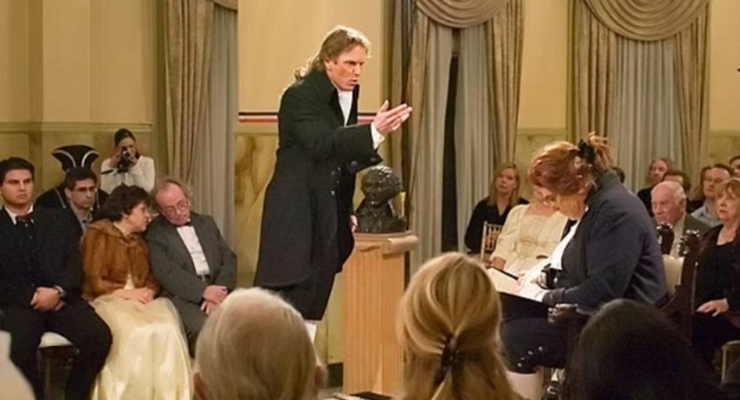
That is the wager at the center of the Thomas Paine Society’s Declaration of Independence Town Hall, where the pamphleteer who helped light the American Revolution — played by Ian Ruskin — is expected to field whatever the audience throws at him, in utterly character.
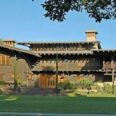
The event runs from 3 to 5 p.m. Sunday, July 5, at Castle Green, the 1898 landmark on South Raymond Avenue where the small nonprofit has been based for three decades. It arrives as the country marks the 250th anniversary of the Declaration of Independence, a milestone the society has chosen to observe not with a lecture but with an argument its members hope will feel alive.
Alaine Lowell, the society’s executive director, plans to open by walking the audience through the Declaration itself — she intends to hand out copies so people can follow along — before turning the floor over to Paine.
“The audience is able to actually ask questions of Thomas Paine, and Ian will answer it as Thomas Paine — what Thomas Paine would say,” Lowell said in an interview. The format is interactive by intent — less a performance to be watched than a conversation to be had.
Ruskin, who trained at the Royal Academy of Dramatic Art (RADA) in London before settling in Los Angeles, has spent more than a decade inhabiting Paine.
His one-man play, To Begin the World Over Again: The Life of Thomas Paine, was filmed by Haskell Wexler and broadcast on PBS; the Los Angeles Times praised its topical resonance and its human feeling. But a scripted stage show and a live town hall demand different muscles. In the play, Paine speaks the lines Ruskin wrote for him. In the town hall, he has to answer strangers — extemporaneously, and in the cadence of a man long dead.
That is a high-wire act, and it is the point. The society and Ruskin came together years ago, when the actor was first developing the play, Lowell said, and the two have been trading historical material ever since.
“We collaborated and helped each other,” she said, describing a long exchange of documents and ideas that has since produced other interactive evenings in which the audience questions a Founder and the Founder — in the person of an actor — answers back.
What makes Paine a natural fit for the exercise, in Lowell’s telling, is the very quality that made Common Sense a runaway bestseller in 1776: he wrote to be understood.
“He had a way of communicating with ordinary people,” she said. “His language was very accessible.”
Where other founding-era prose can feel sealed behind its own formality, Paine’s still reads like speech — which is part of why an actor can pick it up and carry it into an unscripted room.
There is an added charge to interrogating this particular figure, because his place in the founding is itself contested. The society argues that Paine’s contribution to the Declaration was larger than the textbooks allow — a case it is developing into a documentary that the July 5 ticket proceeds help fund. Mainstream historians credit Thomas Jefferson as the Declaration’s principal author, working with the Committee of Five, and treat the stronger claims for Paine’s authorship as unproven. An audience member on Sunday, then, is not simply meeting Paine. They are stepping into a live disagreement about how much of the country’s founding document he can claim — and putting the question to “Paine” himself.
The town-hall format itself has roots in Paine’s own biography, and in the society’s habits.
In Lewes, England, Paine belonged to a debating circle called the Headstrong Club, where members argued the issues of the day and mailed a ceremonial book to whoever had made the best case, to sign.
Paine, Lowell noted, landed in that book more often than anyone.
The Pasadena society has borrowed the spirit for years — through its own “Headstrong Evening Club” debates and a birthday fireside each January — staging the kind of back-and-forth its namesake seems to have relished.
On Sunday, the argument moves to Castle Green’s public rooms, and the man at the center of it will be taking questions. Whether he answers to anyone’s satisfaction is, fittingly, up for debate.
Thomas Paine’s Declaration of Independence Town Hall, part of the 250th anniversary of the Declaration of Independence, will be held Sunday, July 5, 2026, from 3 to 5 p.m. at Historic Castle Green, 99 S. Raymond Avenue, Pasadena. Tickets are $20 per person and $15 for seniors and students, with proceeds supporting the society’s documentary project. Parking is available in public lots and paid structures along Raymond Avenue and Green Street. For more details, visit https://www.
 Get our daily Pasadena newspaper in your email box. Free.
Get all the latest Pasadena news, more than 10 fresh stories daily, 7 days a week at 7 a.m.