










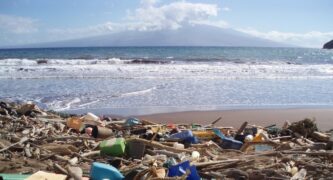

A technology pioneered at NASA’s Jet Propulsion Laboratory in Pasadena is showing promise as a tool for tracking plastic pollution in the world’s oceans, though scientists caution that significant challenges remain before space-based sensors can reliably detect debris at sea.
In late 2025, researchers reported that NASA’s Earth Surface Mineral Dust Source Investigation sensor — known as EMIT — successfully detected concentrations of plastic pollution on land for the first time. The breakthrough has inspired marine scientists to explore whether the same approach could eventually help monitor the estimated 8 million tons or more of plastic that enter the ocean every year.
EMIT, which launched to the International Space Station in 2022, relies on imaging spectroscopy to identify compounds by analyzing unique patterns in reflected sunlight. The technology was developed at JPL, the federally funded research center managed by Caltech, and has been deployed on missions throughout the solar system. A related instrument discovered water on the Moon in 2009, and another is set to return to the Moon to help future astronauts identify scientifically valuable areas to sample.
The sensor was originally designed to map minerals across desert regions to help determine how airborne dust affects atmospheric temperatures. But EMIT has demonstrated remarkable versatility, capable of identifying hundreds of compounds on Earth’s surface from its orbital perch.
“The same technology has now shown that it can find plastic compounds in landfills and large-scale structures like greenhouses,” said JPL’s David Thompson, who coauthored the 2025 study demonstrating EMIT’s plastic detection capabilities.
However, detecting plastic once it enters the ocean is more challenging: Seawater absorbs infrared light, masking many of plastic’s prominent spectral features.
Building a Reference Library
To address that challenge, researchers are working to catalog the spectral signatures of marine debris. NASA intern Ashley Ohall, a Florida native and recent University of Georgia graduate, led a team of collaborators in creating a newly published reference library containing nearly 25,000 molecular “fingerprints” from various types of flotsam and jetsam.
The open-source database compiles years of research in which scientists analyzed marine debris — including rope, tires, metal, bubble wrap, buoys, and bottle caps — using handheld instruments in laboratory settings. Given the prevalence of plastic in marine pollution, the library includes some 19 types of polymer.
Standardizing these datasets into a single searchable repository is essential because different kinds of debris produce slightly different spectra based on material, color, and condition. Weathered water bottles, for example, register differently than debris washed ashore after a hurricane. Once these patterns are cataloged, detection algorithms can be developed for use with remote-sensing instruments.
“My biggest hope is that people see remote sensing as an important and useful tool for marine debris monitoring,” Ohall said. “Just because it hasn’t been done yet doesn’t mean it can’t be done.”
A Planet-Scale Endeavor
Most of the plastic entering the ocean originates on land, so mapping pollution concentrations near coastlines could represent a first step toward reducing what ends up on beaches and eventually washes out to sea.
Carried by ocean currents, debris can travel thousands of miles from its source. A better understanding of where it is and where it’s headed could be a boon for public health and coastal tourism, said Ohall.
Conventional methods for quantifying ocean plastic — including dragging nets through garbage patches — cannot adequately sample the millions of tons flowing through marine environments. With NASA’s support, scientists are evaluating the capabilities of existing sensors while identifying what new technologies may be needed to spot marine debris reliably. Teams are also training AI tools to sift through satellite imagery.
Kelsey Bisson, a program manager at NASA Headquarters in Washington, described the work as a planet-scale endeavor. The foundational research being conducted by Ohall and other scientists brings the effort closer to leveraging powerful technologies already operating in aircraft and spacecraft.
“Humans have a visceral connection to the ocean and its health,” Bisson said. “Detecting marine debris is the kind of incredible challenge that NASA can help solve.”
More information about EMIT is available at earth.jpl.nasa.gov/emit.
 Get our daily Pasadena newspaper in your email box. Free.
Get all the latest Pasadena news, more than 10 fresh stories daily, 7 days a week at 7 a.m.