






The district’s Monday night email closes out a summer in which its board directed staff to evaluate, tree by tree, whether as many as 57 protected trees in Eaton Fire soil remediation work zones could be saved from destruction. It arrived while the district’s authority to remove trees at all remains before a Los Angeles County Superior Court judge, with a trial setting conference scheduled for Oct. 30 and no trial date set.
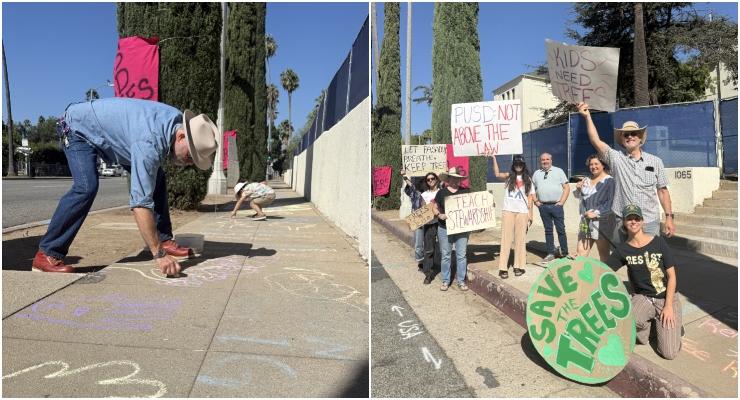
A second demonstration at Longfellow was called for Wednesday morning at the same location.
In its Aug. 31 email, the district said contractors and arborists air-knifed all six trees to a depth of about six inches, and in some spots as much as a foot, and that soil exposed in the process continued to show elevated lead. The district’s arborists concluded that removing more contaminated soil from around the root systems would destabilize structural roots and create a high likelihood of tree failure, the email said.
“Air-knifing” a tree — also called air excavation or air spading — uses a high-pressure, focused jet of compressed air to loosen and remove soil around a tree’s roots. The air breaks apart soil but, when correctly operated, avoids the cutting and tearing that shovels, trenchers and backhoes can cause, exposing roots without severing them. It is the technique the board directed staff to pursue in June, and the one advocates had pressed the district to try.
The district said it also evaluated bioremediation, which it called neither sufficiently reliable nor feasible given the lead concentrations and the years it would take, and capping the soil beneath asphalt or concrete, which it said would leave contamination in place under a land use covenant. It concluded there was no safe, workable alternative to removing the trees in order to return the property to unrestricted educational use.
One of the six, identified in the email as Tree 98, was not listed as protected in the tree inventory provided to the district, but the district said it applied the same preservation standard and analysis to it as to the other five.
The district said the California Department of Toxic Substances Control reviewed its front-lawn excavation analysis and, in an Aug. 31 letter, confirmed that a significant quantity of contaminated soil remains within the trees’ critical root zones. The email quotes the letter as saying that “infrastructure, trees, and vegetation that impede removal of contaminated soil should be removed and replaced as part of the removal action.”
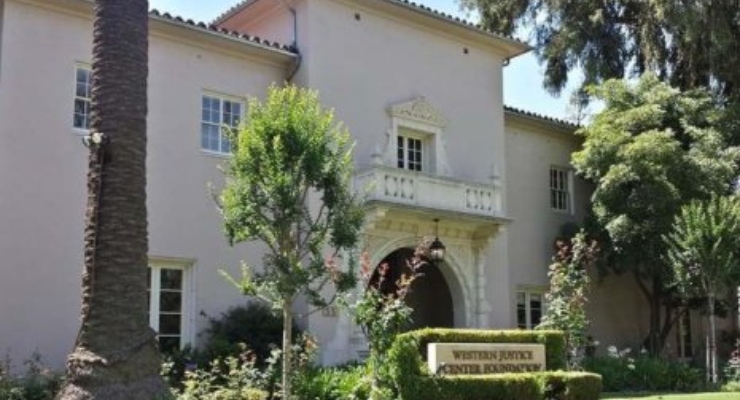
Longfellow, at 1065 E. Washington Blvd., is unoccupied this school year. Its students are attending classes at Allendale Elementary at 1135 S. Euclid Ave. during a $37.9 million bond-funded modernization covering electrical, fire alarm and heating and ventilation systems, window replacement, interior finishes and restrooms.
Jessica Richards, a Longfellow parent and City of Pasadena Urban Forestry Committee member, said she arrived at the school first on Tuesday.
“I was the first person to arrive this morning a bit before 9 a.m. and the towering deodar cedars were the first to greet me,” Richards said. She said Board of Education trustee Scott Harden came to hear the community’s concerns.
Richards disputed the district’s description of the work. She said PUSD’s environmental-remediation contractor, American Integrated Services Inc., “actually excavated down 3 feet in the area just immediately around the trunk of each tree and going down to that depth is problematic for the trees.” That is three times the maximum depth described in the district’s email.
AIS “is NOT an arborist,” Richards said.
Arborist services are not listed among AIS’s publicly described offerings. The company’s website identifies soil remediation, demolition, abatement, waste management and related environmental-construction services.
The district’s email says the air-knifing was carried out by “contractors and arborists” and that “the District’s arborists” reached the conclusion that further excavation would destabilize the trees.
Richards agreed that “an arborist was on site” but believed the arborist “was not actually doing the work nor directing the work.”
“I look forward to seeing the detailed report and testing data, but it seems the design of the attempt was destined to fail,” she said.
Chelsea Brandt, a Longfellow parent and PTA member who lives in the neighborhood, said the district’s email was what brought people out.
“Today was the day to show up because they proved with their email last night that they didn’t really bother to keep their weak promise,” she said.
The district’s position on the record is that trees rooted within excavation areas must be removed before contaminated soil can be safely excavated and replaced. District officials have said roughly 8,000 cubic yards of contaminated soil must come out of 11 campuses, work the district says requires removing and replacing nearly 200 trees. A Notice of Exemption the district filed with the state in March describes the same volume and says the work will require the removal and reasonable replacement of trees. The district claimed a statutory emergency exemption from environmental review, citing the January 2025 state of emergency proclamation covering the Eaton Fire.
The state agency overseeing the cleanup has said more than one method could satisfy it. Benjamin Stanphill, a Southern California division chief at the California Department of Toxic Substances Control, told the school board in June that the agency reviews the district’s proposals and “we are somewhat agnostic to the trees,” adding that the state could accept full soil removal, a long-term land use covenant, or a years-long phytoremediation or bioremediation approach. The district’s email points to the agency’s Aug. 31 letter on Longfellow specifically, and says DTSC’s approved cleanup plan itself anticipated that mature trees on the front lawn would need to be removed.
The board voted unanimously in June to continue the soil removal while directing staff to weigh retention alternatives on a site-by-site basis. The adopted motion did not guarantee any tree’s survival, and a district staff member said a tree whose roots were damaged during excavation would still be removed.
Board members framed the vote as a balance between safety and attachment to the trees; District 3 board member Michelle Richardson Bailey cited a past incident in which “a branch has fallen on a student.”
Counts of the trees involved come from different places and do not line up. Friends of PUSD Trees, the advocacy coalition that has organized against the removals, says on its website that the district is removing 193 trees and lists 15 at Longfellow. As of Tuesday the group posted a running count of 106 trees destroyed to date and put the project’s cost to taxpayers at $6.6 million.
The district has not published a Longfellow-specific tree count. The six front-lawn trees are the only count in its email.
The district said it will plant at least one replacement tree for every tree removed, following its 2026 Landscape and Exterior Space Guidelines, which emphasize native, drought-tolerant and fire-resilient species. It cited a resolution the board adopted Aug. 27 setting a goal of at least 30 percent mature tree canopy coverage in student outdoor areas by 2035, with annual inventory updates and public reporting.
The removals are proceeding under a court order. On Aug. 5, Judge Joseph Lipner issued a preliminary injunction barring the city of Pasadena from issuing stop-work orders against the district’s tree and soil removal at nine campuses, including Longfellow, or enforcing the city’s tree protection ordinance there pending trial.
The city had issued stop-work notices July 1 alleging the district removed protected trees without permits; the board then adopted Resolution 2896 declaring the city’s zoning code inapplicable to the work.
“The City of Pasadena is disappointed with the court’s ruling,” chief communications officer Lisa Derderian said the following morning. “While this is not a final ruling on the merits, the court’s order permits PUSD to remove trees and prohibits the City from enforcing the tree protection ordinance on nine campuses and most of the Education Center pending trial.”
In its opposition the city argued the district’s resolution is invalid on its face because it is not limited to classroom facilities as the state law requires, and that removed trees cannot be revived or replanted in kind.
A district spokesperson said the injunction became necessary because the city reversed its position. “Enforcement of the stop-work notices prevented the District from completing remediation, leaving impacted areas unfinished and jeopardizing students’ access to safe outdoor space when the new school year begins,” the spokesperson said. State law lets a school board declare local zoning inapplicable to a proposed use of district property but bars that step for nonclassroom facilities, the question the court has yet to reach.
Friends of PUSD Trees, which has sued the district and the state toxics agency, says on its website that “there is simply no science that supports tree removal for soil remediation.”
The trial setting conference is set for Oct. 30 in Department 833 at the Stanley Mosk Courthouse. The second Longfellow demonstration is called for Wednesday morning on Washington Boulevard.
 Get our daily Pasadena newspaper in your email box. Free.
Get all the latest Pasadena news, more than 10 fresh stories daily, 7 days a week at 7 a.m.