





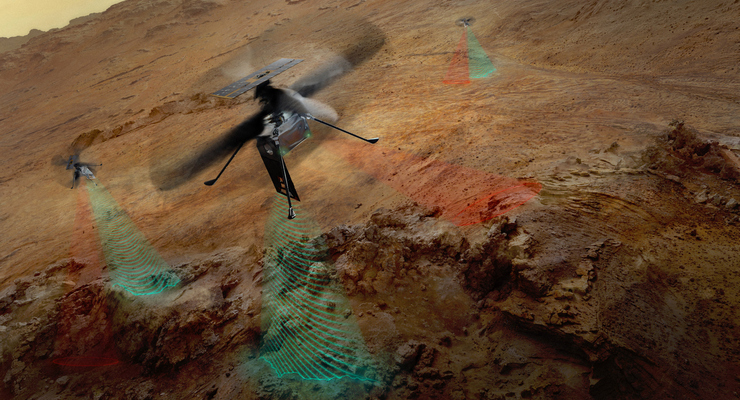
Engineers at NASA’s Jet Propulsion Laboratory in Pasadena have completed a major round of testing on an unusually lightweight, fabric-based radar antenna designed to help three future Mars helicopters search for shallow deposits of frozen water beneath the planet’s surface.
The antenna is being developed for NASA’s SkyFall mission, which is expected to send three rotorcraft to Mars to collect scientific data and examine potential water-ice deposits. NASA detailed the recent antenna tests in an Aug. 6 release from JPL.
Each SkyFall helicopter is expected to carry ground-penetrating radar capable of examining layers immediately below the Martian surface. Engineers faced an unusual design problem: The radar antenna must extend below the helicopter to obtain a clear view of the ground, yet remain flexible enough to bend during landings and return to its proper shape after takeoff.
The technology was demonstrated at JPL in July.
NASA says orbiting spacecraft can detect substantial ice deposits tens of yards beneath Mars, but are less effective at examining the upper several yards of regolith, the layer of broken rock and dust covering the planet.
That relatively shallow region is important for future human exploration because accessible ice could potentially be processed into water, oxygen and fuel.
Adrian Tang, the SkyFall ground-penetrating radar lead instrument scientist at JPL, said helicopters flying close to the surface could produce radar images capable of distinguishing layers of dry soil from underlying ice and mapping how far the ice extends.
SkyFall’s radar is designed to operate across frequencies ranging from 500 to 2,500 megahertz, corresponding to wavelengths of about 24 inches to 5 inches, or 60 to 12 centimeters.
The longer wavelengths can penetrate several yards beneath the surface, while the shorter wavelengths can provide more detailed information about the upper layers of Martian soil and the surface itself.
Those requirements created a problem for the helicopter’s dimensions.
NASA said a conventional antenna operating at those frequencies would need to be about 19 inches, or 48.3 centimeters, long and positioned with an unobstructed view of the ground. The minimum clearance between the Martian surface and the bottom of the SkyFall helicopter’s fuselage, however, is only about 6 inches, or 15.2 centimeters.
Engineers selected a type of antenna known as a Vivaldi, which can transmit and receive signals over a broad range of radio frequencies. Its flat design also allows it to be fabricated from lightweight, flexible, metalized material.
The antenna design was named by its inventor, Peter Gibson, who thought its curved lines resembled a violin, an instrument associated with composer Antonio Vivaldi.
Even a standard Vivaldi antenna was too large for the helicopter, according to NASA. Engineers were able to reduce its dimensions because SkyFall’s radar is intended specifically to survey relatively shallow depths — less than 16 feet, or 5 meters — in dry Martian regolith, which interferes with radio waves less than terrestrial soil.
Christine Gebara, the SkyFall ground-penetrating radar mechanical lead at JPL, said the resulting antenna remains about 1½ times longer than the helicopter’s landing legs.
That means the antenna must bend when the helicopter touches down, bend farther if it encounters a rock and then return to its intended position after the aircraft takes off again. The design also has to withstand that process repeatedly because SkyFall is expected to make dozens of flights.
Engineers covered the antenna in polyester and layers of Vectran, a strong, flexible material previously used in the landing airbags for NASA’s Spirit and Opportunity Mars rovers.
Flexible fiberglass tape springs help the antenna maintain its shape during flight, while a lightweight magnesium structure holds it in place.
The complete assembly weighs about 5 ounces, or 150 grams.
Engineers subjected the prototype to a series of tests at JPL intended to reproduce some of the stresses it could encounter during a mission to Mars.
At JPL’s Environmental Test Laboratory, the antenna was bent into a position that could result from a helicopter landing. Engineers then subjected it to large temperature changes designed to simulate the Martian day-night cycle, during which temperatures can vary by as much as 170 degrees Fahrenheit, or 94 degrees Celsius.
The antenna was repeatedly flexed to simulate dozens of landings.
During the test campaign, engineers stopped six times to move the antenna into an electromagnetic test chamber and determine whether repeated bending and temperature changes had affected its ability to transmit and receive radar signals.
For radiofrequency testing, engineers turned the antenna upside down, placing greater structural stress on it than it would experience under Mars’ gravity, which is about one-third that of Earth.
By the end of testing, the prototype had endured the equivalent of 200 Mars landings — more than twice the number required for a successful prime mission — without a measured loss in radar performance, according to NASA.
Tang said the tests resolved several of the team’s principal technical questions, although additional work is required before the antenna can be considered fully qualified for flight.
The radar team is now building an engineering model for another series of evaluations. Those are expected to include vibration tests, deployment in a simulated Martian environment, additional signal testing and outdoor trials at JPL’s Mars Yard.
Each of SkyFall’s three helicopters is planned to carry four instruments.
The aircraft build on technology demonstrated by NASA’s Ingenuity Mars Helicopter, which completed 72 flights over nearly three years on Mars. Ingenuity demonstrated powered, controlled flight in the planet’s thin atmosphere and also showed how an aerial vehicle could assist surface exploration, including helping the Perseverance rover team evaluate routes and possible science locations.
SkyFall is expected to launch aboard NASA’s Space Reactor-1 Freedom spacecraft in late 2028. The spacecraft is intended to deliver the three helicopters to Mars, where their instruments would collect scientific data and search for potential sources of subsurface water ice.
 Get our daily Pasadena newspaper in your email box. Free.
Get all the latest Pasadena news, more than 10 fresh stories daily, 7 days a week at 7 a.m.