

A few months ago, Ada Gates Patton sat down to lunch with the head of equestrian operations for the Tournament of Roses. She had something to say, and she began carefully: “I think it’s time for me—”
The director cut her off.
“Stop! You are not finishing that sentence. You are never leaving us.”
Gates Patton laughs when she tells the story. But the question she tried to raise — who inherits a job that took decades to invent, in a craft that takes decades to master — is not going away.
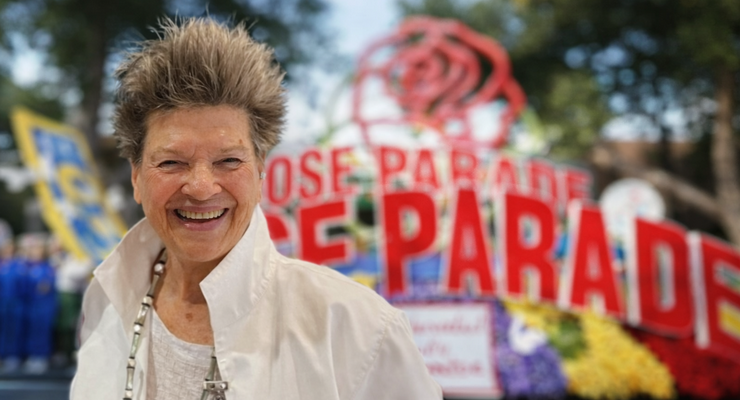
Gates Patton is the official horseshoe inspector for the Rose Parade, the final authority on whether each of the roughly 200 horses staged beneath the 210 freeway at 4 a.m. on New Year’s Day is properly shod to walk Colorado Boulevard. She built the position from nothing over more than 20 years, writing the safety specifications herself, and she enforces them with the calm absolutism of someone who has seen what happens when steel meets wet concrete. She and the parade veterinarians share the power to pull any horse from the lineup.
“Horses wear steel shoes, and steel shoes on pavement are very slippery,” she explained, “especially when you add the hydraulic fluid that comes out of floats spontaneously, and that’s oil. That combined with the cement is very slippery. So we cannot have horses falling down.”
The physics are unforgiving. A thousand-pound animal losing its footing on live television, in a crowd of thousands, surrounded by children on the curb — the calculation is simple. Gates Patton’s job is to make certain it never happens.
Her authority is absolute, her rulebook strict: only steel shoes fitted with traction pins, or barefoot horses already accustomed to working unshod. No rubber. No plastic. No composite materials nailed or glued. No boots. No brand advertising anywhere.
When one group showed up to EquestFest with more than 20 horses wearing bright red boots emblazoned with a vendor’s name, she delivered the news without negotiation. They changed before the parade.
“If people don’t care for that and they’re upset about it, I’d say, ‘I’m terribly sorry. You don’t have to go in this parade if you don’t want to.'”
The road to this authority began with rejection.
As a young woman, Ada Gates left Long Island for Colorado, chasing an improbable dream: to become a farrier, one of the craftspeople who shoe horses, in an era when the trade was almost exclusively male. She found work hard to come by.
“Before I became licensed, I was rejected by ranchers in Colorado when I first started out,” she recalled. “I was hired, thankfully, by housewives that wanted me to come and take care of their ponies, their daughter’s pony, which was fine.”
She took the work. She got better. And eventually, the ranchers came around — not from any change of heart, but from necessity.
“Eventually I did start working for ranchers because they really were desperate for a horseshoer,” she said, “and so they had to get over having me.”
She became the first woman farrier since International Union of Journeymen Horseshoers (IUJH) was established in 1874.
In 1978, she earned her license to shoe Thoroughbred racehorses at Santa Anita Race Track — the first woman to hold such a license in both the United States and Canada.
The accolades accumulated: farrier liaison for the 1984 Los Angeles Olympics equestrian competition, the Edward Martin Humanitarian Award from the American Farrier’s Association, induction into the International Horseshoeing Hall of Fame. She married fellow farrier Harry Patton; after his death in 2000, she continued operating his horseshoeing supply business in Monrovia.
Somewhere along the way, the Tournament of Roses recognized that its parade had a problem — hundreds of horses, miles of concrete, no systematic safety protocol — and that Gates Patton was the person to solve it.
The challenge of succession is not merely administrative. It is temporal.
Gates Patton describes her craft with the clear-eyed honesty of someone who has spent a lifetime doing hard physical labor in service of animals that cannot speak for themselves.
“It’s a very tough job,” she said. “It takes two years to get fit, it takes 10 years to sort of maybe be okay, and it takes 20 years to be really, really good.”
She paused, then continued: “During those 20 years, you better serve apprenticeships, you better go to clinics, you better stay awake, and you better have the drive to be good and to be a servant to the horse. If not, you shouldn’t be in the business.”
Twenty years. That is the timeline for mastery — not competence, but the deep knowledge required to spot trouble before it happens, to understand what a horse’s movement reveals about its soundness, to know when a hoof trimmed too recently will fail under parade conditions.
The Rose Parade inspection role demands more still: the institutional memory of two decades of accumulated judgment calls, the relationships with veterinarians and equestrian marshals, the diplomatic skill to tell a proud rider that their horse isn’t going anywhere.
This year, a new man will shadow Gates Patton through the entire process — the September committee meetings, the December inspections, the pre-dawn hours on New Year’s morning in the cold and dark beneath the freeway overpass.
“He was a Marine, is now an excellent horseshoer,” she said. “He knows how to speak, command, and lead. He’d be great. We’ll see if it works out. Down the road.”
Down the road. That is where the question lives, unanswered.
Gates Patton has already made one accidental innovation in the role. After foot surgery left her unable to walk well, she could not perform her usual 4 a.m. inspection of every horse in the dark on parade morning. She asked instead to check the horses in daylight at the EquestFest rehearsal, days before January 1.
“It was wonderful,” she said. “In the daylight with plenty of time, able to check every horse and my horseshoer able to fix any horses not in compliance.”
The system worked so well it became permanent. She still spot-checks horses on parade morning — “one or two or four or five horses in each group,” selected randomly so that all must be ready — but the high-pressure pre-dawn scramble is no longer the only line of defense.
It is the kind of institutional wisdom that lives in one person’s head until it doesn’t. The Tournament of Roses has spent more than a century perfecting the visible spectacle: the floats, the bands, the grand marshal waving from the back of a convertible. The invisible work — a woman with a flashlight checking hooves at 4 a.m. — took longer to formalize, and its transfer to the next generation is only now being considered.
The Marine will shadow her this year. Perhaps he will shadow her again the next. At some point, if all goes well, he will stand alone in the cold and dark, making the calls that keep horses upright and crowds safe, carrying forward knowledge that took a lifetime to accumulate.
Ada Gates Patton, who once shod ponies for housewives because ranchers wouldn’t hire a woman, has spent more than four decades proving what she could do. The question now is whether anyone else can learn it fast enough.
Ada Gates Patton owns Harry Patton Horseshoeing Supplies in Monrovia, California, and is past president of the California Thoroughbred Foundation Board of Directors, after 12 years of service.
 Get our daily Pasadena newspaper in your email box. Free.
Get all the latest Pasadena news, more than 10 fresh stories daily, 7 days a week at 7 a.m.