




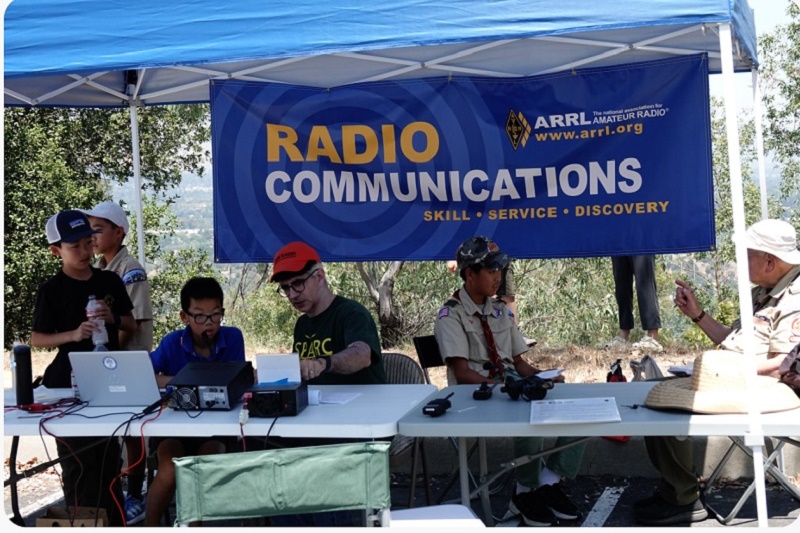
By Friday evening, two trailer-mounted towers will rise above the south parking lot at ArtCenter College of Design, antennas fanning out in every direction. Tables will follow, then radios, then batteries, then solar panels. By Saturday morning, what was a slab of asphalt at the edge of the San Rafael Hills will be a functioning six-station communications outpost, staffed by operators from four amateur radio clubs, running entirely off the grid.
By Sunday afternoon, it will all be gone.
The 24-hour exercise is ARRL Field Day, the largest annual amateur radio event in the United States, drawing more than 30,000 operators to temporary sites across the country each year, according to the American Radio Relay League. This year’s local operation — a joint effort by the Pasadena Radio Club, the South Pasadena Amateur Radio Club, the JPL Amateur Radio Club, and the Caltech Amateur Radio Club — marks the third consecutive year the four groups have come together at ArtCenter after the COVID-19 pandemic shut down the in-person gathering from 2020 through 2023.
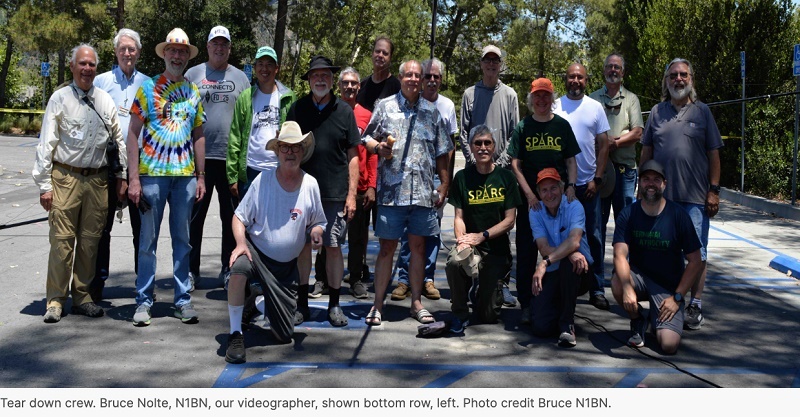
“Just before COVID in 2019, the field day was largely sponsored by the Pasadena Radio Club,” said Tom Bruegge, president of the South Pasadena Amateur Radio Club. “It was a large event.”

Then it went dark. Monthly meetings stopped. The parking lot sat empty on the last weekend of June. When the clubs came back in 2024, they combined four organizations to pool their numbers — partly because no one was sure who would show up.
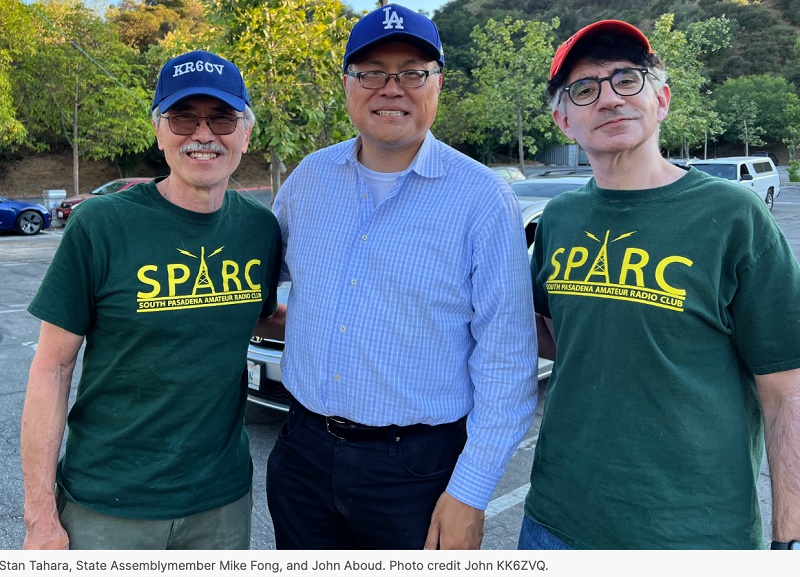
“We had a decent turnout, and last year was a bit better, and we’re hoping this year again to gather even more people,” Bruegge said. “The nature of the event is the same. It was just the number of attendees was larger pre-COVID, and we’re trying to just bring back those numbers and enthusiasm.”

Carol Bruegge, a Field Day co-chair and member of all four participating clubs, said the first thing visitors will notice is the hardware. “The most obvious thing that they’ll see is two trailers that have these huge towers mounted to them,” she said. “At the top of each tower are these antennas that go out in all directions.”
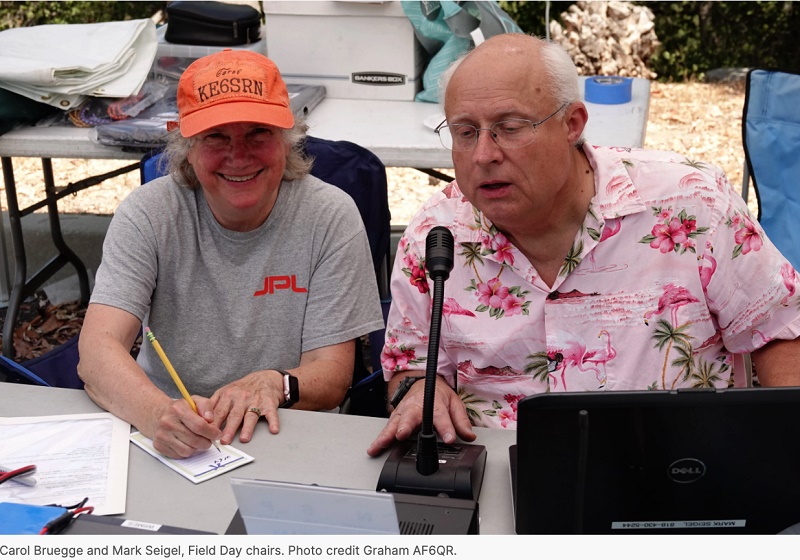
Below the towers, six stations will run simultaneously — two operating voice communications on high-frequency bands capable of reaching across the continent, one transmitting in Morse code, one running digital modes, and one handling VHF and UHF links. Each station will be powered by paired batteries, recharged during the day by solar panels and at night by generators. The four clubs will operate under the special event call sign N6P.
Among the operators will be members of the JPL Amateur Radio Club, an organization founded in the 1950s at the Jet Propulsion Laboratory. During the Voyager mission’s flybys of Jupiter and Saturn, the club transmitted live slow-scan television images to hobbyists around the world under its W6VIO call sign. Dr. Alexandra Holloway, the club’s president, said the ArtCenter site — perched on a hill above the Rose Bowl with a clear drop-off angle in multiple directions — was chosen for its radio propagation.
“The parking lot is completely empty until we show up and we raise the antennas and we bring out the generators,” Holloway said. “And then at the end of it, we take it all down again and it’s again just a parking lot. That’s a really powerful thing to see come and go.”
Field Day is formally designated as an emergency-preparedness exercise. For 24 hours, operators establish and maintain communications using only emergency power, independent of the commercial electrical grid — simulating the conditions that follow when cell towers, internet service, and power lines fail simultaneously. In a community where the January 2025 Eaton Fire killed at least 19 people, destroyed more than 9,000 structures across Altadena and Pasadena, and overwhelmed cell infrastructure in the burn area, the exercise has a local frame of reference.
Tom Bruegge said amateur radio’s organized role during the Eaton Fire was limited. “We had some overloaded cell phone towers and some destroyed cell phone towers in the burn area, but we did not have a massive communication failure,” he said. Individual operators monitored emergency traffic and helped where they could, Bruegge said, but because commercial networks did not fully collapse, a large-scale organized amateur radio response was not needed.
The larger concern, Bruegge said, is an earthquake — the scenario where fiber-optic connections are severed and cell infrastructure collapses across a wide area. Amateur Radio Emergency Service volunteers in the region drill weekly to relay hospital-status reports by radio when no other link exists, he said, and Field Day is where those skills are practiced under sustained, realistic conditions.
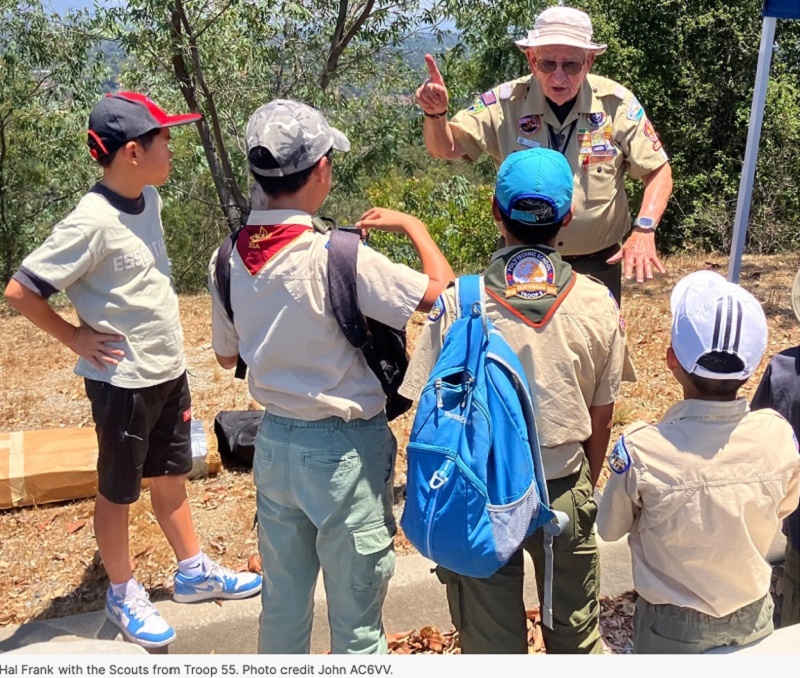
The event is free and open to the public. From 1 p.m. to 5 p.m. Saturday, a dedicated “Get On The Air” station will let visitors — including those with no amateur radio license or prior experience — sit down, pick up a microphone, and make contacts with stations across the country under the guidance of licensed operators. Carol Bruegge said a local scout leader brings two troops to the station to earn radio merit badges, and that young visitors are a particular draw.
“These youth just kind of bring an excitement to the air,” she said.
For anyone whose curiosity survives Saturday afternoon, the path to a license is shorter than most people assume. Applicants study from a pool of 350 questions and sit for a 35-question multiple-choice exam, with a passing score of 74 percent. No Morse code test is required. “I think a lot of times people have the impression, which is false, that you have to be some sort of a really technologically savvy or technologically oriented person to get a ham radio license,” Tom Bruegge said. “And that is absolutely not the case.” Both of his children were licensed at age 8.
Operations run from 11 a.m. Saturday, June 27, through 11 a.m. Sunday, June 28, in the south parking lot of ArtCenter College of Design’s Hillside Campus, entered from 1700 Lida Street, Pasadena. A guardhouse controls entry to the campus; visitors can tell the attendant they are there for the radio field day and will be directed to the lot. No registration or sign-up is required. For more information, contact the Field Day coordinators at fd@w6ka.net.
 Get our daily Pasadena newspaper in your email box. Free.
Get all the latest Pasadena news, more than 10 fresh stories daily, 7 days a week at 7 a.m.