









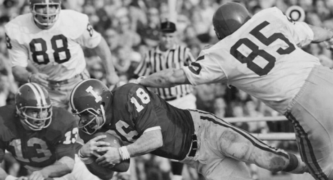


Indiana will return to the Rose Bowl Game for the first time since 1968.
The Hoosiers punched their ticket to the Grandaddy of them All after earning a first-round bye with a 13-0 record.
The Hoosiers captured the Big Ten championship and are led by head coach Curt Cignetti, Alabama’s recruiting coordinator and wide receivers coach, along with Heisman Trophy-winning quarterback Fernando Mendoza.
The last time Indiana played in the Rose Bowl, the country stood at the edge of a historic rupture.
It was Jan. 1, 1968. The Indiana Hoosiers arrived in Pasadena for what was then a rare Big Ten appearance in college football’s most tradition-bound game. Indiana had earned its spot after the conference relaxed its long-standing “no-repeat” rule, opening the door for the program’s first Rose Bowl berth. Awaiting the Hoosiers was USC Trojans, playing before a crowd steeped in pageantry and sunshine.
Indiana lost 14–3. But the game itself was only a small part of what defined that moment in American life.
Across the country, the United States was deeply embroiled in the Vietnam War. Lyndon B. Johnson occupied the White House, while troop deployments overseas and rising casualty counts fueled anger and anxiety at home. College campuses — including those much like Indiana’s — had become centers of protest, with students questioning authority, institutions and the future they were inheriting.
The civil rights movement, though buoyed by landmark legislation earlier in the decade, was entering one of its most volatile periods. The nation was still reeling from the urban unrest of the previous summer, including the 1967 Detroit uprising. Martin Luther King Jr. was alive and speaking forcefully about economic justice and the war, unaware that his assassination was only three months away.
Television brought all of it into American living rooms. Many households still watched in black and white as network anchors narrated war footage, protest marches and college football games with the same steady cadence. Walter Cronkite had become the most trusted voice in the country, and the Rose Bowl was part of a media ecosystem that increasingly blurred the line between sport and national life.
Popular culture was shifting just as dramatically. The Beatles were no longer touring and were reshaping music in the studio, while soul and rock artists pushed songs toward political and social commentary.
Michael Jackson and his brothers had not released their first album with Motown.
Youth culture was asserting itself loudly, visibly and often confrontationally.
Against that backdrop, Indiana’s appearance in the Rose Bowl came during a brief pause before the storm of 1968 fully broke — before the assassinations, before the Democratic National Convention in Chicago, before the year that would permanently alter American politics, culture and sports.
More than five decades later, Indiana’s return to the Rose Bowl arrives in a radically different landscape: an expanded College Football Playoff, year-round media coverage and a sport transformed by television money and player compensation. But the memory of 1968 lingers as a reminder of just how long it has been — and how much has changed — since the Hoosiers last stepped onto college football’s grandest New Year’s stage.
 Get our daily Pasadena newspaper in your email box. Free.
Get all the latest Pasadena news, more than 10 fresh stories daily, 7 days a week at 7 a.m.