







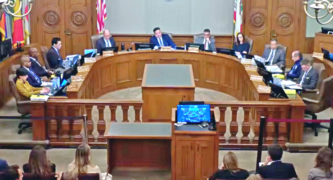

The City Council voted 8-0 late Monday night to deny an appeal and approve concept design review for a four-story, 93,539-square-foot research and development building on Caltech-owned property at 1364 E. Green St., in spite of arguments from neighbors who said the project would harm an adjacent Catholic school and church.
The vote, which came after hours of testimony from more than 50 speakers and the receipt of 728 letters expressing concerns and/or opposition, upheld the Design Commission’s January approval and cleared the project to proceed to final design review. Thirty-one letters in support of the project were also received.
The appeal had been filed Feb. 9 by Building a Better Pasadena LLC, which cited concerns about the adequacy of the project’s environmental studies, traffic impacts and consistency with the city’s General Plan, East Colorado Specific Plan and Zoning Code.
Local attorney Richard McDonald represented the appellant.
The project, proposed by TC LA Development Inc., would replace a surface parking lot at the southeast corner of Green Street and Holliston Avenue with a research and development facility featuring 260 at-grade and subterranean parking spaces on the 41,573-square-foot site. Nancy Moses, who identified herself as working at Trammell Crow Company, presented the project to the council.
Neighbors Raise Safety, Traffic Concerns
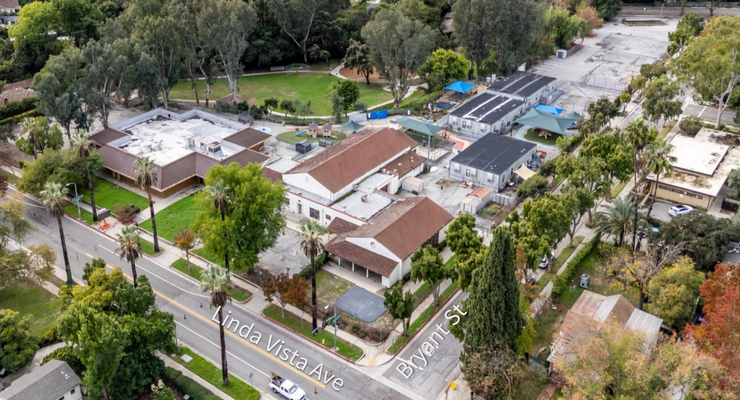
Much of the opposition centered on the project’s proximity to St. Philip the Apostle Church and School, whose campus sits immediately east and south of the site.
Parents, parishioners and a Caltech biology professor who sends his children to the school raised concerns about laboratory safety, construction impacts, traffic congestion during school drop-off and pick-up, and the building’s scale next to a campus with young children, including transitional kindergarten students.
The appellant’s traffic engineer, Grant Johnson, testified that the city’s traffic studies were insufficient, particularly regarding queuing on Holliston Avenue, where the school’s daily drop-off line occupies the narrow street. He said the project would bring roughly 1,100 vehicle trips per day to a street only 30 feet wide with parking on one side.
City staff and their traffic consultants, Fehr & Peers, countered that the project would not create significant traffic impacts. The city’s Department of Transportation conducted a separate Local Mobility Analysis — outside the scope of the California Environmental Quality Act — and found that nearby intersections would continue to operate at acceptable levels.
Staff: Project Complies With All Standards
Principal City Planner Kevin Johnson told the council the project meets all applicable development standards of the Zoning Code, including setbacks, parking, open space, floor area and height. The research and development use is permitted by right in the EC-MU-N zoning district under the East Colorado Specific Plan. The only required entitlement is design review.
Johnson said the project qualifies for a CEQA Class 32 categorical exemption for infill development. Technical studies on noise, air quality and traffic prepared by EcoTierra Consulting and Fehr & Peers found less-than-significant impacts in all categories.
Pasadena Planning Director Jennifer Paige noted that the city’s review was limited to design review findings and the environmental determination. She said design review cannot reduce the size of a building below what the Zoning Code allows.
Applicant Offers Voluntary Reductions
Moses told the council the applicant was voluntarily offering to reduce the building’s total height, including the mechanical screen, from the allowable 81 feet to 73 feet. The applicant also agreed to eliminate one level of subterranean parking, reducing the underground structure from three levels to two and cutting the parking count from 260 to 200 stalls, a move that would shorten the construction timeline.
The Design Commission had approved the project 5-0, with three members absent, on Jan. 27 after two public hearings. The commission had imposed conditions requiring the applicant to restudy the fourth-floor massing along the south elevation and to consider using Green Street for construction traffic.
Council Adds Voluntary Conditions
Before voting, the council added several voluntary conditions accepted by the applicant. Council Member Lyon requested a covenant restricting the building to Biosafety Level 1 and 2 use in perpetuity, which the applicant agreed to. Mayor Gordo asked for air monitoring during construction, which the applicant also accepted.
Councilmember Madison, participating remotely, raised a procedural question about whether the BSL restriction fell within the scope of design review. Paige confirmed it did not, but the applicant’s voluntary acceptance resolved the issue. Assistant City Attorney Caroline Monroy clarified that the design review findings could be reached without the voluntary conditions, but the applicant was agreeing to them independently.
Councilmembers Express Sympathy but Cite Legal Constraints
Councilmember Rick Cole, who spoke at length before the vote, said the matter had touched him personally as a longtime Catholic school parent and parish council member but that the council’s jurisdiction was limited to design review and the CEQA determination.
“It is not picking sides between jobs and schools. It’s not picking sides between Caltech and St. Philip the Apostle,” Cole said. “It’s not taking sides between the eloquent people on each side of the issue tonight. It’s applying the law to the responsibilities we have to make a decision tonight.”
Cole noted that the property could have been developed by right as an eight-story residential building or a four-story commercial office building, and said he was prepared to trust the Design Commission and staff.
Vice Mayor Jess Rivas said she supported the staff recommendation, noting there was substantial evidence to support it. Councilmember Masuda said he believed the project should be found exempt from CEQA and the appeal should be denied.
Mayor Victor Gordo, who disclosed that his family has been a parishioner of St. Philip’s for over 50 years, said he found persuasive the by-right nature of the project, the multiple layers of safety regulation governing laboratory uses and the educational partnership opportunities between Caltech and neighborhood children.
Councilmember Steve Madison, while voting in favor, cautioned the council about conditioning the design review approval on matters outside the scope of the proceeding.
Next Steps
Cole said city staff should establish a construction monitoring committee including the applicant, Caltech and the neighbors at St. Philip the Apostle; to have the Department of Transportation work with the institutional uses on traffic issues; and to ask the Planning Commission to reexamine the city’s research and development ordinance to determine whether additional protections are warranted near schools, including possible BSL regulations.
Madison did not join that request, saying it was not appropriate for a midnight discussion and should be taken up at a future meeting without regard to this project.
The project now proceeds to final design review before the Design Commission, where construction details, finishes, materials, landscaping and compliance with the conditions of approval will be examined.
 Get our daily Pasadena newspaper in your email box. Free.
Get all the latest Pasadena news, more than 10 fresh stories daily, 7 days a week at 7 a.m.