






Residents are pressing city leaders to adopt stronger protections against federal immigration enforcement, with public comments ahead of Monday night’s City Council meeting revealing deep concern over surveillance, civil liberties and the use of local resources.
The City Council is set to review a staff report outlining proposed measures to mitigate the impacts of federal immigration enforcement on city resources, property and community safety. The item is listed for discussion, though council members may take action following deliberation.
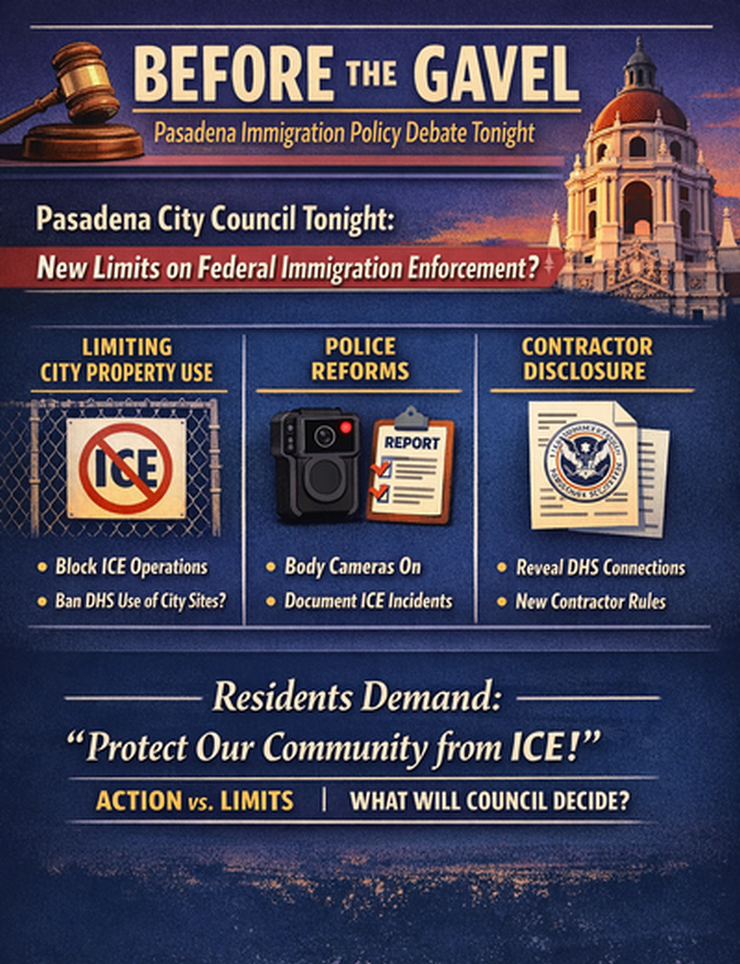
The report details efforts to restrict the use of city-owned property for immigration enforcement activities, implement new police protocols requiring documentation and body-worn camera use during enforcement encounters, and establish monthly public reporting.
Council members are also expected to consider requiring city contractors to disclose ties to the Department of Homeland Security and whether to move forward with formal policies or ordinances, including a possible broader ban on the use of city property for enforcement purposes. The discussion comes as officials weigh legal constraints alongside growing community calls for stronger protections and transparency.
A series of emails submitted to the City Clerk shows a consistent message: residents want the city to go further.
“I do not support the use of my local tax dollars, city infrastructure, or public safety resources to assist federal civil immigration enforcement activities,” wrote Katerina Mesesan, a District 2 resident.
“These systems raise serious concerns about privacy and potential misuse,” she added, urging the city to prohibit surveillance tools such as Flock cameras.
Concerns about surveillance and privacy surfaced repeatedly in the correspondence. “Today, more than ever, privacy is public safety,” wrote a commenter identified as Yadi, who called on the city to reconsider automated license plate readers and similar technologies.
Others focused on civil rights and oversight. “Residents must be able to exercise their rights to observe, document, and speak freely,” wrote Daniela Navin, a District 3 resident.
“Public spaces should be safe and welcoming for all residents, and they should never be used as staging areas,” she added, calling for stronger protections for legal observers and clearer accountability measures.
Navin also raised concerns about equity in enforcement tools. “Surveillance should not disproportionately impact vulnerable communities,” she wrote, pointing to a concentration of cameras in historically underserved neighborhoods.
Some comments reflected frustration and urgency over enforcement tactics. “There are masked men refusing to identify themselves and kidnapping human beings in broad daylight under your watch,” wrote Andy Carazo. “Immediately cease supporting them,” he added.
Claire Phillips of Pasadena and Altadena framed the issue in economic and moral terms. “Partnering and favoring ICE is a moral crime,” Phillips wrote.
“Altadena is in the midst of rebuilding — without immigrant labor, we cannot return. Let’s not lie to ourselves,” she added.
 Get our daily Pasadena newspaper in your email box. Free.
Get all the latest Pasadena news, more than 10 fresh stories daily, 7 days a week at 7 a.m.