







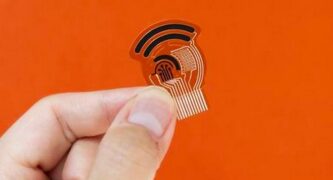
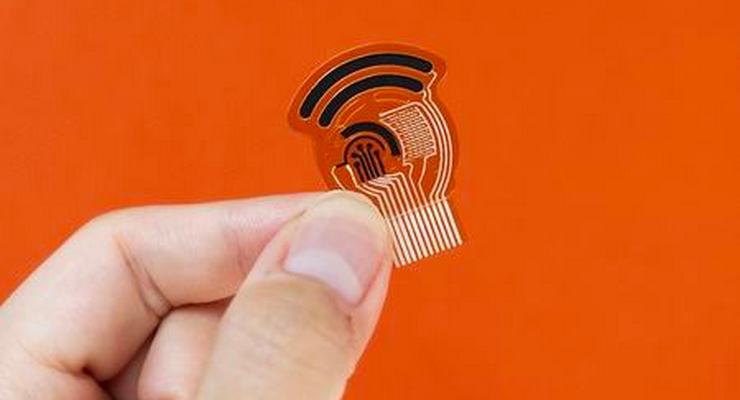
If you see a doctor regularly, chances are you have had a lipid panel ordered and your blood drawn at a lab. The results told your physician about your levels of cholesterol and triglycerides, factors that play a role in diagnosing conditions such as cardiovascular diseases and diabetes. Now, a team led by Wei Gao, a professor in Caltech’s Cherng Department of Medical Engineering, has developed a stick-on patch capable of gathering the same lipid measurements by analyzing sweat. And it can do so not just once but continuously.
The new noninvasive sensor uses machine learning to estimate levels of lipids in the blood based on what is measured in the sweat. The relationship between lipids in sweat and lipids in blood is not linear—a plot of the relationship between measurements and what is found in the blood does not follow a straight line. The causal machine learning model takes into consideration various physiological factors that might affect those sweat measurements such as body mass index (BMI), sex, and how much a person is sweating to produce an estimate of blood lipid levels.
“Together, the sweat measurement and the causal machine learning model can predict the blood level with high accuracy,” says Gao, who is also a Heritage Medical Research Institute Investigator.
Gao and his colleagues describe the new lipid profiling device and results of preclinical testing on 24 participants in a paper in the journal Nature Sensors. The lead authors of the paper are all from Gao’s group at Caltech: José A. Lasalde-Ramírez, a graduate student; Chihyeong Won, a visitor at Caltech; and Sijie Ji, a senior postdoctoral scholar research associate.
Gao says the wearable device could play an important role in giving people an early warning related to cardiovascular or metabolic diseases. “How many people actually get their blood drawn regularly? I haven’t done this myself for at least two years probably,” Gao says. “That’s why we think a noninvasive way of monitoring lipids will be critical.”
Gao’s group has previously developed noninvasive tests for glucose and uric acid, but he says the continuous detection of lipids posed a bigger challenge. For example, much of the cholesterol in sweat is present in a chemical form called esterified cholesterol, which cannot be detected directly. The researchers therefore developed a two-step enzymatic reaction: The first step converts esterified cholesterol into free cholesterol, and the second oxidizes the free cholesterol to generate hydrogen peroxide, which can then be measured by the sensor. They also had to figure out a way to trap a supply of ATP (adenosine triphosphate), the cell’s primary energy source, in a special polymer built into the wearable patch. That way it could gradually release ATP into a user’s sweat, allowing the polymer system to sustain the ATP supply needed for triglyceride sensing for more than 20 hours.
The paper is titled “Non-invasive continuous lipid profiling via cofactor-refreshing cascading enzymatic reactions and causal machine learning.” Authors Soyoung Shin, Robin M. McDonald, Katherine Karish, Gwangmook Kim, Hong Hang, Daniel Mukasa, Yu Song, and Juliane R. Sempionatto, contributed to the work while at Caltech. Sempionatto also contributed while at Rice University. Brian Arianpour, Tzung K. Hsiai, and Zhaoping Li are authors from UCLA. Li and author Jieping Yang are from the David Geffen School of Medicine at UCLA. The work was supported by funding from the National Science Foundation, the National Institutes of Health, Samsung Research America, and the Heritage Medical Research Institute.
 Get our daily Pasadena newspaper in your email box. Free.
Get all the latest Pasadena news, more than 10 fresh stories daily, 7 days a week at 7 a.m.