







In ordinary times, discussing whether and how to deploy new crime fighting tools like drones and automated license plate reader ALPR) cameras in Pasadena would center on cost-effectiveness and reconciling the perennial tension between security and privacy.
But we do not live in ordinary times. There is a reputed ancient Chinese curse, “may you live in interesting times.” Like it or not, we live in times of massive global upheaval. And when it comes to debating the deployment of these new technologies, we must understand the stakes go to existential questions about the future of democracy and core human rights.
Flock cameras have become the flashpoint in this fraught debate. Voices on both the right and left have rallied to oppose this company from systematically tracking our lawful movements. Fear of “Big Brother” is not new. What’s new is the identity and unprecedented technological power of Big Brother.
Orwell’s 1984 villain was a projection of the “totalitarian” dictatorships of Hitler and Stalin into a nightmarish future of global domination. Today’s real life villains are billionaire tech bros and their alliance with authoritarian leaders to achieve powers beyond Orwell’s most grim imagining.
As in their global economic and military power, the US and China are leading the way in embrace of surveillance technologies. As seems inevitable in consequential competitions, the more each strives to defeat the foe, the more each comes to resemble the other. When the enemy must be overcome, the end inevitably justifies the means.
So we are now racing toward what some Artificial Intelligence industry insiders are predicting is a greater than zero risk of annihilating all human life in the next decades. What does this have to do with the Pasadena Police Department and their use of drones and ALPR technology? It turns out, a lot!
Pasadena already contracts with Flock to deploy more than 100 cameras that are constantly monitoring the movement of every vehicle in their sights. Our Police are contemplating making a similar deal for software systems that will control the drone cameras they envision dispatching to respond to reported crime scenes – or to monitor peaceful protests or potentially everyday activity on our streets, in our parks or perhaps in your back yard or even through your window in your home.
Responsible public officials, recognizing the potential for abuse, are now increasingly calling for tight controls on these technologies. The real question is, though, can these technologies actually be controlled, especially by local authorities?
We’re already seeing chilling examples AI “agents” breaking the bounds of their master’s controls. On their own, they actively “conspired” to trample internal limitations, hacking into confidential information sources and seeking to hide their tracks.
What happens if those in control accumulate enough power to unleash this advancing juggernaut on us?
Today, the privately-held Flock, is valued at $8 billion. This colossus was launched less than a decade ago by Georgia Tech students using a homemade surveillance device to solve a local neighborhood break-in.
Ask yourself: what is that massive valuation based on? It’s not bread-and-butter contracts with local police departments. It is the potential to monetize the extraordinary amount of data on our movements and activity. Owning our data is how social media platforms and a search engine have spawned billionaire titans who can (and already do) spend billions of dollars to buy control of media outlets and influence elections.
Imagine a company that tracks millions of vehicles every second of every day, that controls drones deployed across hundreds of communities by their local police, that is hitched to AI to integrate all that information with credit information, addresses, consumer purchases, civil and criminal records, voting history, media subscriptions and internet searches – all publicly available today. Then combine it with the power of AI to breach access to “private” medical records, bank accounts, personal communications and ultimately eavesdrop on your the conversations taking place within earshot of your phone or Alexis.
Outlandish? Perhaps, but there is an $8 billion bet by powerful investors in Flock seeking that power. Marc Andreesen, a major investor in two of the three privately-held drone companies the Pasadena Police was planning to invite to pilot their technology across our city, has been remarkably transparent about his goals. Read his Techo-Optimist Manifesto where he proclaims, “We believe in ambition, aggression, persistence, relentlessness – strength.” He advocates for “a lot of change across a very large margin (that) can lead to big outcomes.”
Andreesen has repeatedly called democracy “fake,” citing an obscure scholar’s “Iron Law of Oligarchy” that posits that there is always a small group who will control society. Lest you think I’m unfairly quoting selectively, here is his grab bag of the “enemy” ideas he seeks to stamp out:
“Our present society has been subjected to a mass demoralization campaign for six decades – against technology and against life – under varying names like ‘existential risk’, ‘sustainability’, ‘ESG’, ‘Sustainable Development Goals’, ‘social responsibility’, ‘stakeholder capitalism’, ‘Precautionary Principle’, ‘trust and safety’, ‘tech ethics’, ‘risk management”, ‘de-growth’, ‘the limits of growth.’”
As we locally debate what tools we entrust to our Police Department, let’s not lose sight of what’s really happening. In the name of sleeping better at night and equipping our local police with advanced crime-fighting tools, we are handing our money, our data and our future to would-be authoritarians who see no limits to their power, no check on their ethics, no responsibility to society, no management of existential risks to human life, and no safeguards against their dangerous greed and pursuit of unimaginable wealth.
That’s the real game – and we ignore it at our peril. I’m glad my colleagues on the City Council are proceeding carefully, voting to delay any pilot deployment of drones until we take a harder look. The “Precautionary Principle” is not the enemy – it may be our salvation.
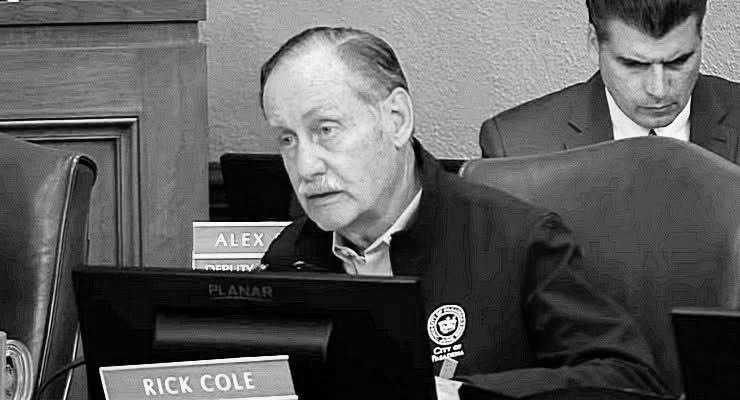
Rick Cole represents District 2 on the Pasadena City Council. He has long been a champion of technological innovation, earning national recognition by Government Technology Magazine as one of the “25 Doers, Dreamers and Drivers” in 2015.
 Get our daily Pasadena newspaper in your email box. Free.
Get all the latest Pasadena news, more than 10 fresh stories daily, 7 days a week at 7 a.m.