


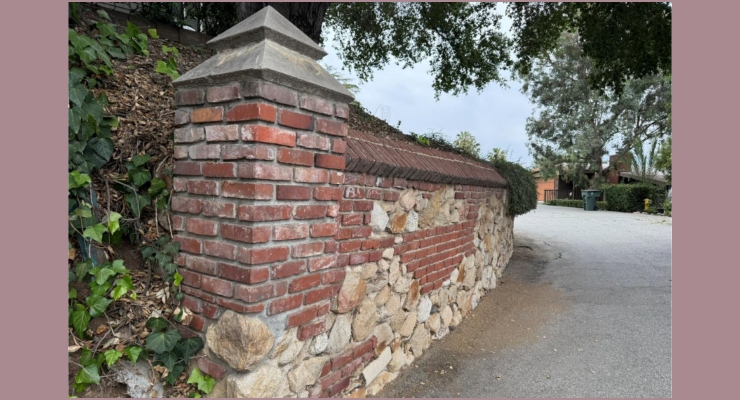
The wall fronts three properties at 333, 353, and 375 Anita Drive in the Cheviotdale Heights neighborhood, according to a report by the Planning and Community Development Department. Built in 1926, the Tudor Revival-style structure originally served a single residence but now spans three separate lots.
Property owner E.J. Remson of 375 Anita Drive submitted the landmark application in March, the report said. The other two property owners support the designation.
Planning Director Jennifer Paige recommends approval, finding the wall meets criteria for artistic significance. The retaining wall is composed of brick, concrete and Arroyo stones with a peaked brick cap.
The structure features brick and stone pillars topped with tiered pyramidal concrete caps. Original wrought iron gates provide pedestrian and vehicular access to the middle property.
The report said Donald R. Wilkinson designed the wall as part of his work on the house at 353 Anita Drive. That residence is already listed in the National Register of Historic Places.
Wilkinson worked with the prominent architectural firm Meyer & Holler, which designed Grauman’s Chinese Theater and other notable Southern California buildings. He studied at the Chicago Art Institute and received a diploma from Ecole des Beaux-Arts in Paris.
The wall originally extended across one large property owned by W.D. Jones. Later subdivisions created the current three lots, with houses built in 1940 and 1950 on the adjoining parcels.
Driveway openings were cut through the wall to serve the newer properties. The southern opening maintains pillars similar to the original design. The northern opening features simpler concrete walls.
Planning staff found the retaining wall retains high architectural integrity in its location, design, materials and workmanship, the report said. The structure demonstrates Tudor Revival characteristics applied to landscape architecture.
The wall ranges from three to five feet in height and follows the sloping topography. It remains in good condition with no significant changes proposed.
Tudor Revival architecture began appearing in Pasadena in the 1910s for single-family residences and estates. The style draws from 16th century English building techniques.
If approved by the commission, the recommendation will advance to the City Council for final designation. The landmark status would apply only to the retaining wall itself.
The commission meeting begins at 6:30 p.m. Tuesday at City Hall.
 Get our daily Pasadena newspaper in your email box. Free.
Get all the latest Pasadena news, more than 10 fresh stories daily, 7 days a week at 7 a.m.


