











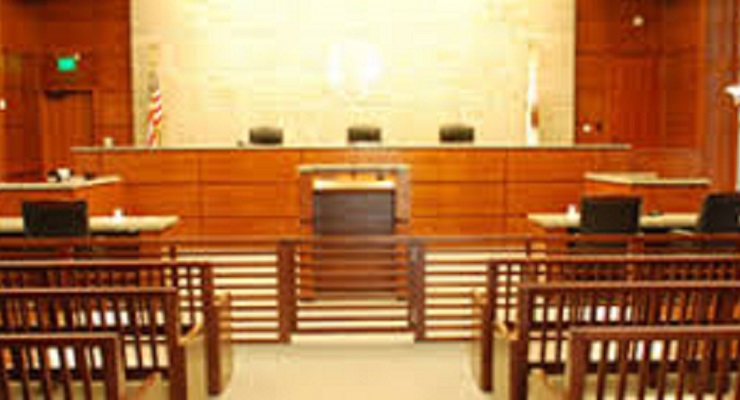
Inside the historic Chambers Courthouse on Grand Avenue overlooking the Arroyo Seco, attorneys squared off Wednesday over whether 600,000 Venezuelan immigrants can be stripped of their legal right to remain in the United States.
The U.S. Court of Appeals for the Ninth Circuit heard oral arguments in a case that has ping-ponged between lower courts and the Supreme Court for nearly a year. At stake: Temporary Protected Status, a humanitarian program that has shielded Venezuelans from deportation since 2021.
Ahilan Arulanantham, a UCLA law professor representing the immigrants, told the three-judge panel that the harm has already begun. “We absolutely have shown harm in all 50 states,” he said, describing job losses, detentions, and families torn apart.
Sarah Welch, arguing for the Department of Justice, urged the panel to reverse the lower court and let the termination stand. She noted the Supreme Court has twice intervened in favor of the administration—in May and October 2025—allowing the policy to proceed while litigation continues.
“Congress also limited judicial review in the TPS statute,” Welch told the judges.
The hearing came one week after the first anniversary of the Eaton Fire that devastated nearby Altadena, in a courthouse that has served Pasadena since 1985. The Richard H. Chambers building, a Spanish Colonial Revival landmark originally built as the Vista del Arroyo Hotel in the 1920s, is one of four locations where the Ninth Circuit holds sessions.
The three-judge panel—Circuit Judges Kim McLane Wardlaw, Salvador Mendoza Jr., and Anthony D. Johnstone—made no ruling Wednesday. Whatever they decide, the case is expected to return to the Supreme Court.
The dispute began in the final days of the Biden administration, when Homeland Security Secretary Alejandro Mayorkas extended TPS for Venezuelans through October 2026. Two weeks later, the new DHS Secretary, Kristi Noem, vacated that extension—an action Judge Edward Chen of San Francisco called unprecedented in the program’s 35-year history.
Chen blocked the termination twice, finding it likely violated federal law. The Ninth Circuit affirmed his reasoning in August. But the Supreme Court, in a pair of unexplained orders on its emergency docket, allowed deportations to continue while litigation proceeds.
Justice Ketanji Brown Jackson, the sole written dissenter in October, called the court’s intervention “yet another grave misuse of our emergency docket.”
For now, Venezuelan TPS holders remain in legal limbo. Their protections were supposed to last until October 2026. Instead, the 2023 designation terminated in April 2025, and the 2021 designation ended in November.
“Today’s hearing comes as hundreds of thousands of Venezuelans live in fear,” Arulanantham said in a statement, “uncertain if this administration will deport them back to a country that is suffering and near economic collapse.”
Cecilia Gonzalez, a Venezuelan plaintiff, said the lawsuit has given her hope. “My home country is in absolute crisis,” she said. “This is exactly the type of situation that TPS was created to address.”
The case also challenges the termination of protections for roughly 330,000 Haitians, though that issue was not argued Wednesday. Haiti’s TPS is set to expire February 3.
Wardlaw, a Clinton appointee, previously called the timeline of Noem’s decision “troubling.” Mendoza, appointed by Biden, questioned during an earlier hearing whether any administration had ever revoked an existing TPS designation. The answer was no.
The Ninth Circuit will issue a decision at a later date.
 Get our daily Pasadena newspaper in your email box. Free.
Get all the latest Pasadena news, more than 10 fresh stories daily, 7 days a week at 7 a.m.