


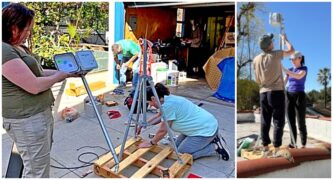


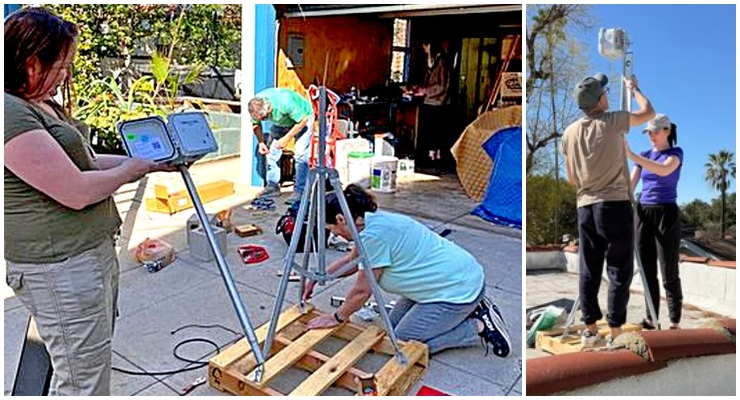
Manuel Carmona, Director of Public Health, announced the deployment of the professional air quality sensor at the Pasadena Public Health Department. The sensor provides real-time estimates of particulate matter concentrations, including PM10, and will support monitoring during wildfire cleanup activities to help assess the effectiveness of fugitive dust control measures.
The city’s sensor joins a network of more than 25 QuantAQ Modulair-PM air quality sensors deployed across Altadena and Pasadena. This network, known as the PHOENIX network (Post-fire airborne Hazard Observation Environmental Network for Integrated Xposure-monitoring), makes air quality data publicly available through a user-friendly map.
Several air quality sensors were destroyed by the wildfire, creating gaps in regional air monitoring capabilities. In response to heightened community concerns, a California Institute of Technology team developed plans to place new sensors in areas lacking coverage. The first sensors were deployed in February 2025, with data collection beginning immediately.
The network allows residents to view air quality data specific to their neighborhoods, homes, and workplaces. The project is expected to continue through fall 2026.
The Caltech team leading this initiative includes Haroula Baliaka, a Ph.D. Candidate in Environmental Science and Engineering; Paul Wennberg, R. Stanton Avery Professor of Atmospheric Chemistry and Environmental Science and Engineering; Coleen Roehl, Associate Research Scientist in Environmental Science and Engineering; and Nikos Kanakaris, Machine Learning Researcher.
PM10, or particulate matter measuring 10 micrometers or smaller in diameter, can include dust, smoke, pollen, and other airborne substances. These particles can irritate the eyes, nose, and throat, causing symptoms like coughing, wheezing, and congestion. While the wildfire has increased concerns about airborne particulate matter, these particles also come from vehicle emissions, industrial activities, construction sites, and natural sources such as dust storms.
Health officials encourage everyone to take precautions and limit outdoor activities when PM10 levels and general air quality reach unhealthy levels.
 Get our daily Pasadena newspaper in your email box. Free.
Get all the latest Pasadena news, more than 10 fresh stories daily, 7 days a week at 7 a.m.


