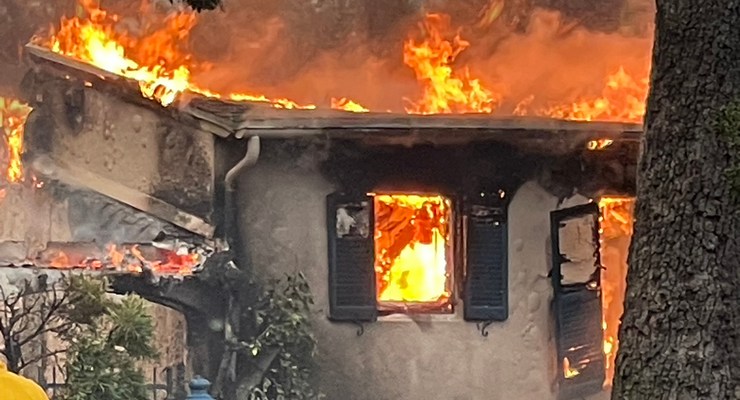







The UL Research Institutes’ Fire Safety Research Institute released the 724-page report Friday, which served to examine the conditions, decisions, actions and systems that influenced wildfire and community conflagration outcomes before and during the fires. The report represents the second phase of an independent analysis conducted by the institute.
While the analysis recognizes the California’s past and recent investments in fire prevention, preparedness and response programs, the scale and speed of the January 2025 fires exceeded many assumptions underlying those systems, the report found.
“The fires revealed implementation challenges, operational limitations and areas where policies and practices have not evolved at the same pace as the wildfire risk facing California communities,” the report reads. “The report further reinforces that incremental improvements to individual programs alone will not be sufficient to address future wildfire risk.”
“Long-term risk reduction requires coordinated action that improves wildfire resilience at the community, regional and state and federal levels,” according to the report.
Key findings confirmed previously reported issues uncovered by the Los Angeles Times and other news organizations, regarding the city and county’s response, specifically how the Los Angeles Fire Department failed to act on warnings that the Lachman fire was still burning underground — that then burned into the Palisades fire days later.
LAFD firefighters contained the Lachman fire at Topanga State Park on Jan. 1, 2025. Park officials asked for a trail that had to be cut to reach the fire be covered with vegetation, and later asked LAFD to remove a hose that had been there for a year to fight a previous fire, the report read.
The L.A. Times reported in October 2025 that firefighters raised concerns about removing that hose and that one captain reported seeing smoke, while other personnel said they didn’t find hot spots from the Lachman fire. A battalion chief ultimately ordered crews to remove the hose.
According to the investigation, there was no evidence that showed LAFD went back to the site to patrol for hot spots prior to anticipated extreme fire weather.
Investigators recommended that LAFD create a culture or empower their firefighters to inform command about hot spots, among other concerns. Command staff were encouraged to evaluate and resolve any concerns before crews are assigned elsewhere or removed from the area.
Among other issues the report found, LAFD lacked experience with major fires, lacked proper communication with more-experienced agencies, and had challenges with tracking its own firefighters.
The report found that the Los Angeles Police Department, which led evacuation efforts, did not work under the same command as the fire department. The two city departments were working with two different evacuation maps.
In addition, Topanga State Park, also affected by the fire, failed to consult fire agencies for the creation of its wildfire plan, according to the report, which found that the draft of the Topanga State Park Wildfire Management Plan did not receive feedback nor input from fire agencies. Park officials prioritized fire-suppression priorities over environmental concerns.
Meanwhile, the L.A. County Fire Department, which served as the lead agency handling the Eaton fire that began in foothills of Altadena, had significant communication issues that resulted in critical information never reaching incident commanders, the report found.
At one point, the LACoFD joined with LAFD, but later began operating independently after recognizing the “inadequacy of the current command organization,” the report showed.
Similar challenges involving disorganization and lack of communication between city departments were also found within the county’s fire and sheriff’s departments. A Times investigation found that fire trucks were slow to move westward following a radio report of fire moving west at 2:19 a.m.
The investigation confirmed that fire resources were still east of Lake Avenue and spread out over several miles, and impacted how the department was able to respond to the emergency.
The LACoFD Incident Command was “unaware that the fire had progressed through west Altadena until the daylight hours on January 8, 2025,” according to the report. “By that time, most of the structures in west Altadena had already been impacted by the fire.”
Findings showed that fire officials failed to use advanced technology such as satellite imagery after strong winds prevented aircraft from assisting in the skies. The Times also reported that the federal government’s FireGuard program could have provided imaging.
In May, the county released the findings of an independent investigation conducted by Citygate Associates, which also examined evacuation decisions, incident communications and fire behavior during the critical overnight hours between 9 p.m. on Jan. 7 and 6 a.m. on Jan. 8, 2025.
Based on interviews, operational records, dispatch information and incident communications, the investigation concluded that fire command officials acted “appropriately amidst unprecedented fire and weather conditions that grounded aircraft, leaving them without aerial surveillance to track the spread of the Eaton fire in real-time,” according to the fire department.
 Get our daily Pasadena newspaper in your email box. Free.
Get all the latest Pasadena news, more than 10 fresh stories daily, 7 days a week at 7 a.m.