







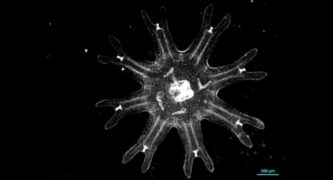

Credit: A. Sharma
Although increased cell proliferation is a hallmark of cancerous tissues, in some cases, it may actually be protective against tumor growth, according to a new study from Caltech researchers. Using mathematical models, the work suggests a new paradigm for the earliest stages of cancer development. Subsequent experiments in jellyfish, a particularly cancer-resistant model organism, support the idea that high rates of cellular proliferation enable tissues to conduct quality control or “proofreading” in order to destroy cells that could become cancerous.
The study is described in a paper appearing in the journal Proceedings of the National Academy of Sciences on August 18. The work is a collaboration between the laboratories of Lea Goentoro, professor of biology; and John Doyle, the Jean-Lou Chameau Professor of Control and Dynamical Systems, Electrical Engineering, and Bioengineering, Emeritus.
Cancers occur when cells’ normal abilities to grow and divide go haywire, causing uncontrolled growth that forms tumors. This can occur more often in older age as cells accumulate and pass down mutations that add up over time. The more cells divide, the higher the cancer risk; indeed, certain highly proliferating tissues like those of the colon and the skin develop cancers more frequently than nonproliferative cells such as neurons in the central nervous system. But this paradigm does not quite tell the whole story.
Paradoxically, certain large, long-lived animals like elephants develop cancers rarely, though they have many more cells and live much longer than smaller organisms like mice. Curiously, various jellyfish species essentially never get cancers, even when exposed to carcinogens. Why?
In the new study, former Caltech graduate student Dr. Anish Sarma (PhD ’22) built upon mathematical models of cancer that describe the interconnected rates of cell proliferation, mutation, and death. Tissues must maintain a harmonious balance between these basic processes, destroying cells that have accumulated mutations and growing new ones to replace the old. Sarma wanted to know if it is possible for an organism to achieve normal tissue maintenance while also having low rates of abnormal growths. The team focused on modeling the occurrence of neoplasia, a type of abnormal growth that includes cancers and precancers.
Surprisingly, the model showed that high rates of proliferation could lead to lower rates of neoplasia. While this runs counter to the conventional paradigm that proliferation increases the chance of mutation, the team hypothesized that it may occur because a tissue that produces more cells than it needs can be more aggressive in its quality control: Any cell that looks a little defective is destroyed and easily replaced, a process the authors call “proofreading.” The proofreading is surprisingly effective even with only a slight bias to remove defective cells. Paradoxically, the model showed that lowering rates of proliferation could cause a tissue to accumulate mutations that lead to neoplasia.
To test these new predictions experimentally, the team turned to the moon jellyfish (Aurelia aurita), which Goentoro’s lab frequently studies. These jellyfish, which are common in oceans worldwide, are known to be rather cancer resistant—even when exposed to carcinogens, they rarely develop tumors. Notably, jellyfish have the ability to proliferate their cells and can do so to regenerate tissue after injury, yet they do not develop cancers.
Sarma conducted several experiments with the jellies. First, he verified that carcinogen exposure does not lead to abnormal growths in normal jellyfish. Then, he disabled the jellies’ abilities to kill their own cells, a process called apoptosis. When exposed to carcinogens, these animals indeed developed abnormal growths. Next, Sarma treated jellies to block their cells’ ability to proliferate; when these animals were exposed to carcinogens, they also developed abnormal growths. Finally, he restored the animals’ cell proliferation ability, and those jellies did not develop neoplasms. The experiments suggest that higher rates of cell proliferation do indeed improve the ability to kill neoplastic cells.
Since regulations of cell proliferation and apoptosis that underlie tissue maintenance are universal features of all animal cells, this same proofreading mechanism may also be present in human tissues. If so, then the development of cancer can be reframed as a failure of proofreading, and one could envision a cancer-prevention strategy that encourages cell proliferation to induce the body’s own proofreading system to clear out abnormalities before cancers develop, rather than simply killing cancer cells after they arise.
The paradigm could also help make sense of childhood cancers; in young individuals, cells haven’t lived long enough to accumulate mutations as in the traditional models, which has left researchers and clinicians puzzled about how these diseases arise.
“The model is built to be generalizable to study other cancerous systems,” Sarma says.
In future work, the team will apply their jellyfish findings to examine whether proliferation is protective against neoplasia in human tissues. Sarma, now a resident physician in pediatrics at Boston Children’s Hospital and Boston Medical Center, plans to investigate the model’s applicability to early cancer development, particularly in children.
The work is a prime example of interdisciplinary collaboration at Caltech. Doyle, an engineer, became interested in applying the principles of the field of control theory to cancer and other biological problems in the early 2000s. A core concept of control theory is the existence feedback loops through which a system—biological or otherwise—takes and adjusts inputs, over and over, to maintain a steady state. In a healthy tissue, the rates of cell death and cell proliferation are tightly coupled, making it an ideal system for the application and study of control-theory models. To that end, Doyle is working with oncologists at City of Hope to apply these models to understand metastatic breast cancers.
Meanwhile, on the experimental side, Goentoro has developed tools to tinker with jellyfish in the laboratory, allowing her group and collaborators to use the seemingly simple creatures to make major discoveries about sleep in brainless animals, and about how animals regenerate limbs after damage, among other work.
For years, Goentoro and Doyle had been mulling over the question of why jellyfish do not get cancer. Together, the two decided to use the animals as a system for testing control-theory-driven models of cancer, and Sarma’s expertise as a graduate student lay perfectly at the intersection of their laboratories’ work.
“Proofreading using cell turnover was a surprise to all of us,” Sarma says. “We saw the possibility mathematically and thought, ‘That can’t be right,’ and then experiments confirmed it. The collaboration was planned, but the project, in good Caltech fashion, unfolded in a series of conversations and discoveries.”
“The project also could not be where it is now,” adds Goentoro, “if it were not, in good Caltech tradition, for a fiercely independent graduate student unafraid to take their advisors to wholly new directions. We were fortunate that at the early stages of the idea, when we did not have much data but lots of curiosity, we were helped by the Carver Mead New Adventures Fund. That truly catalyzed the project.”
The paper is titled “Proliferation as a natural strategy to suppress neoplasia.” Funding was provided by the Army Research Office Multidisciplinary University Research Initiative and Caltech’s Carver Mead New Adventures Fund.
 Get our daily Pasadena newspaper in your email box. Free.
Get all the latest Pasadena news, more than 10 fresh stories daily, 7 days a week at 7 a.m.